PK`ZZZJH�vccrequests/__init__.py# __
# /__) _ _ _ _ _/ _
# / ( (- (/ (/ (- _) / _)
# /
"""
Requests HTTP Library
~~~~~~~~~~~~~~~~~~~~~
Requests is an HTTP library, written in Python, for human beings.
Basic GET usage:
>>> import requests
>>> r = requests.get('https://www.python.org')
>>> r.status_code
200
>>> b'Python is a programming language' in r.content
True
... or POST:
>>> payload = dict(key1='value1', key2='value2')
>>> r = requests.post('https://httpbin.org/post', data=payload)
>>> print(r.text)
{
...
"form": {
"key1": "value1",
"key2": "value2"
},
...
}
The other HTTP methods are supported - see `requests.api`. Full documentation
is at <https://requests.readthedocs.io>.
:copyright: (c) 2017 by Kenneth Reitz.
:license: Apache 2.0, see LICENSE for more details.
"""
import warnings
import urllib3
from .exceptions import RequestsDependencyWarning
try:
from charset_normalizer import __version__ as charset_normalizer_version
except ImportError:
charset_normalizer_version = None
try:
from chardet import __version__ as chardet_version
except ImportError:
chardet_version = None
def check_compatibility(urllib3_version, chardet_version, charset_normalizer_version):
urllib3_version = urllib3_version.split(".")
assert urllib3_version != ["dev"] # Verify urllib3 isn't installed from git.
# Sometimes, urllib3 only reports its version as 16.1.
if len(urllib3_version) == 2:
urllib3_version.append("0")
# Check urllib3 for compatibility.
major, minor, patch = urllib3_version # noqa: F811
major, minor, patch = int(major), int(minor), int(patch)
# urllib3 >= 1.21.1
assert major >= 1
if major == 1:
assert minor >= 21
# Check charset_normalizer for compatibility.
if chardet_version:
major, minor, patch = chardet_version.split(".")[:3]
major, minor, patch = int(major), int(minor), int(patch)
# chardet_version >= 3.0.2, < 6.0.0
assert (3, 0, 2) <= (major, minor, patch) < (6, 0, 0)
elif charset_normalizer_version:
major, minor, patch = charset_normalizer_version.split(".")[:3]
major, minor, patch = int(major), int(minor), int(patch)
# charset_normalizer >= 2.0.0 < 4.0.0
assert (2, 0, 0) <= (major, minor, patch) < (4, 0, 0)
else:
raise Exception("You need either charset_normalizer or chardet installed")
def _check_cryptography(cryptography_version):
# cryptography < 1.3.4
try:
cryptography_version = list(map(int, cryptography_version.split(".")))
except ValueError:
return
if cryptography_version < [1, 3, 4]:
warning = "Old version of cryptography ({}) may cause slowdown.".format(
cryptography_version
)
warnings.warn(warning, RequestsDependencyWarning)
# Check imported dependencies for compatibility.
try:
check_compatibility(
urllib3.__version__, chardet_version, charset_normalizer_version
)
except (AssertionError, ValueError):
warnings.warn(
"urllib3 ({}) or chardet ({})/charset_normalizer ({}) doesn't match a supported "
"version!".format(
urllib3.__version__, chardet_version, charset_normalizer_version
),
RequestsDependencyWarning,
)
# Attempt to enable urllib3's fallback for SNI support
# if the standard library doesn't support SNI or the
# 'ssl' library isn't available.
try:
try:
import ssl
except ImportError:
ssl = None
if not getattr(ssl, "HAS_SNI", False):
from urllib3.contrib import pyopenssl
pyopenssl.inject_into_urllib3()
# Check cryptography version
from cryptography import __version__ as cryptography_version
_check_cryptography(cryptography_version)
except ImportError:
pass
# urllib3's DependencyWarnings should be silenced.
from urllib3.exceptions import DependencyWarning
warnings.simplefilter("ignore", DependencyWarning)
# Set default logging handler to avoid "No handler found" warnings.
import logging
from logging import NullHandler
from . import packages, utils
from .__version__ import (
__author__,
__author_email__,
__build__,
__cake__,
__copyright__,
__description__,
__license__,
__title__,
__url__,
__version__,
)
from .api import delete, get, head, options, patch, post, put, request
from .exceptions import (
ConnectionError,
ConnectTimeout,
FileModeWarning,
HTTPError,
JSONDecodeError,
ReadTimeout,
RequestException,
Timeout,
TooManyRedirects,
URLRequired,
)
from .models import PreparedRequest, Request, Response
from .sessions import Session, session
from .status_codes import codes
logging.getLogger(__name__).addHandler(NullHandler())
# FileModeWarnings go off per the default.
warnings.simplefilter("default", FileModeWarning, append=True)
PK`ZZZ�E���requests/__version__.py# .-. .-. .-. . . .-. .-. .-. .-.
# |( |- |.| | | |- `-. | `-.
# ' ' `-' `-`.`-' `-' `-' ' `-'
__title__ = "requests"
__description__ = "Python HTTP for Humans."
__url__ = "https://requests.readthedocs.io"
__version__ = "2.31.0"
__build__ = 0x023100
__author__ = "Kenneth Reitz"
__author_email__ = "me@kennethreitz.org"
__license__ = "Apache 2.0"
__copyright__ = "Copyright Kenneth Reitz"
__cake__ = "\u2728 \U0001f370 \u2728"
PK`ZZZ�(����requests/_internal_utils.py"""
requests._internal_utils
~~~~~~~~~~~~~~
Provides utility functions that are consumed internally by Requests
which depend on extremely few external helpers (such as compat)
"""
import re
from .compat import builtin_str
_VALID_HEADER_NAME_RE_BYTE = re.compile(rb"^[^:\s][^:\r\n]*$")
_VALID_HEADER_NAME_RE_STR = re.compile(r"^[^:\s][^:\r\n]*$")
_VALID_HEADER_VALUE_RE_BYTE = re.compile(rb"^\S[^\r\n]*$|^$")
_VALID_HEADER_VALUE_RE_STR = re.compile(r"^\S[^\r\n]*$|^$")
_HEADER_VALIDATORS_STR = (_VALID_HEADER_NAME_RE_STR, _VALID_HEADER_VALUE_RE_STR)
_HEADER_VALIDATORS_BYTE = (_VALID_HEADER_NAME_RE_BYTE, _VALID_HEADER_VALUE_RE_BYTE)
HEADER_VALIDATORS = {
bytes: _HEADER_VALIDATORS_BYTE,
str: _HEADER_VALIDATORS_STR,
}
def to_native_string(string, encoding="ascii"):
"""Given a string object, regardless of type, returns a representation of
that string in the native string type, encoding and decoding where
necessary. This assumes ASCII unless told otherwise.
"""
if isinstance(string, builtin_str):
out = string
else:
out = string.decode(encoding)
return out
def unicode_is_ascii(u_string):
"""Determine if unicode string only contains ASCII characters.
:param str u_string: unicode string to check. Must be unicode
and not Python 2 `str`.
:rtype: bool
"""
assert isinstance(u_string, str)
try:
u_string.encode("ascii")
return True
except UnicodeEncodeError:
return False
PK`ZZZT� (aLaLrequests/adapters.py"""
requests.adapters
~~~~~~~~~~~~~~~~~
This module contains the transport adapters that Requests uses to define
and maintain connections.
"""
import os.path
import socket # noqa: F401
from urllib3.exceptions import ClosedPoolError, ConnectTimeoutError
from urllib3.exceptions import HTTPError as _HTTPError
from urllib3.exceptions import InvalidHeader as _InvalidHeader
from urllib3.exceptions import (
LocationValueError,
MaxRetryError,
NewConnectionError,
ProtocolError,
)
from urllib3.exceptions import ProxyError as _ProxyError
from urllib3.exceptions import ReadTimeoutError, ResponseError
from urllib3.exceptions import SSLError as _SSLError
from urllib3.poolmanager import PoolManager, proxy_from_url
from urllib3.util import Timeout as TimeoutSauce
from urllib3.util import parse_url
from urllib3.util.retry import Retry
from .auth import _basic_auth_str
from .compat import basestring, urlparse
from .cookies import extract_cookies_to_jar
from .exceptions import (
ConnectionError,
ConnectTimeout,
InvalidHeader,
InvalidProxyURL,
InvalidSchema,
InvalidURL,
ProxyError,
ReadTimeout,
RetryError,
SSLError,
)
from .models import Response
from .structures import CaseInsensitiveDict
from .utils import (
DEFAULT_CA_BUNDLE_PATH,
extract_zipped_paths,
get_auth_from_url,
get_encoding_from_headers,
prepend_scheme_if_needed,
select_proxy,
urldefragauth,
)
try:
from urllib3.contrib.socks import SOCKSProxyManager
except ImportError:
def SOCKSProxyManager(*args, **kwargs):
raise InvalidSchema("Missing dependencies for SOCKS support.")
DEFAULT_POOLBLOCK = False
DEFAULT_POOLSIZE = 10
DEFAULT_RETRIES = 0
DEFAULT_POOL_TIMEOUT = None
class BaseAdapter:
"""The Base Transport Adapter"""
def __init__(self):
super().__init__()
def send(
self, request, stream=False, timeout=None, verify=True, cert=None, proxies=None
):
"""Sends PreparedRequest object. Returns Response object.
:param request: The :class:`PreparedRequest <PreparedRequest>` being sent.
:param stream: (optional) Whether to stream the request content.
:param timeout: (optional) How long to wait for the server to send
data before giving up, as a float, or a :ref:`(connect timeout,
read timeout) <timeouts>` tuple.
:type timeout: float or tuple
:param verify: (optional) Either a boolean, in which case it controls whether we verify
the server's TLS certificate, or a string, in which case it must be a path
to a CA bundle to use
:param cert: (optional) Any user-provided SSL certificate to be trusted.
:param proxies: (optional) The proxies dictionary to apply to the request.
"""
raise NotImplementedError
def close(self):
"""Cleans up adapter specific items."""
raise NotImplementedError
class HTTPAdapter(BaseAdapter):
"""The built-in HTTP Adapter for urllib3.
Provides a general-case interface for Requests sessions to contact HTTP and
HTTPS urls by implementing the Transport Adapter interface. This class will
usually be created by the :class:`Session <Session>` class under the
covers.
:param pool_connections: The number of urllib3 connection pools to cache.
:param pool_maxsize: The maximum number of connections to save in the pool.
:param max_retries: The maximum number of retries each connection
should attempt. Note, this applies only to failed DNS lookups, socket
connections and connection timeouts, never to requests where data has
made it to the server. By default, Requests does not retry failed
connections. If you need granular control over the conditions under
which we retry a request, import urllib3's ``Retry`` class and pass
that instead.
:param pool_block: Whether the connection pool should block for connections.
Usage::
>>> import requests
>>> s = requests.Session()
>>> a = requests.adapters.HTTPAdapter(max_retries=3)
>>> s.mount('http://', a)
"""
__attrs__ = [
"max_retries",
"config",
"_pool_connections",
"_pool_maxsize",
"_pool_block",
]
def __init__(
self,
pool_connections=DEFAULT_POOLSIZE,
pool_maxsize=DEFAULT_POOLSIZE,
max_retries=DEFAULT_RETRIES,
pool_block=DEFAULT_POOLBLOCK,
):
if max_retries == DEFAULT_RETRIES:
self.max_retries = Retry(0, read=False)
else:
self.max_retries = Retry.from_int(max_retries)
self.config = {}
self.proxy_manager = {}
super().__init__()
self._pool_connections = pool_connections
self._pool_maxsize = pool_maxsize
self._pool_block = pool_block
self.init_poolmanager(pool_connections, pool_maxsize, block=pool_block)
def __getstate__(self):
return {attr: getattr(self, attr, None) for attr in self.__attrs__}
def __setstate__(self, state):
# Can't handle by adding 'proxy_manager' to self.__attrs__ because
# self.poolmanager uses a lambda function, which isn't pickleable.
self.proxy_manager = {}
self.config = {}
for attr, value in state.items():
setattr(self, attr, value)
self.init_poolmanager(
self._pool_connections, self._pool_maxsize, block=self._pool_block
)
def init_poolmanager(
self, connections, maxsize, block=DEFAULT_POOLBLOCK, **pool_kwargs
):
"""Initializes a urllib3 PoolManager.
This method should not be called from user code, and is only
exposed for use when subclassing the
:class:`HTTPAdapter <requests.adapters.HTTPAdapter>`.
:param connections: The number of urllib3 connection pools to cache.
:param maxsize: The maximum number of connections to save in the pool.
:param block: Block when no free connections are available.
:param pool_kwargs: Extra keyword arguments used to initialize the Pool Manager.
"""
# save these values for pickling
self._pool_connections = connections
self._pool_maxsize = maxsize
self._pool_block = block
self.poolmanager = PoolManager(
num_pools=connections,
maxsize=maxsize,
block=block,
**pool_kwargs,
)
def proxy_manager_for(self, proxy, **proxy_kwargs):
"""Return urllib3 ProxyManager for the given proxy.
This method should not be called from user code, and is only
exposed for use when subclassing the
:class:`HTTPAdapter <requests.adapters.HTTPAdapter>`.
:param proxy: The proxy to return a urllib3 ProxyManager for.
:param proxy_kwargs: Extra keyword arguments used to configure the Proxy Manager.
:returns: ProxyManager
:rtype: urllib3.ProxyManager
"""
if proxy in self.proxy_manager:
manager = self.proxy_manager[proxy]
elif proxy.lower().startswith("socks"):
username, password = get_auth_from_url(proxy)
manager = self.proxy_manager[proxy] = SOCKSProxyManager(
proxy,
username=username,
password=password,
num_pools=self._pool_connections,
maxsize=self._pool_maxsize,
block=self._pool_block,
**proxy_kwargs,
)
else:
proxy_headers = self.proxy_headers(proxy)
manager = self.proxy_manager[proxy] = proxy_from_url(
proxy,
proxy_headers=proxy_headers,
num_pools=self._pool_connections,
maxsize=self._pool_maxsize,
block=self._pool_block,
**proxy_kwargs,
)
return manager
def cert_verify(self, conn, url, verify, cert):
"""Verify a SSL certificate. This method should not be called from user
code, and is only exposed for use when subclassing the
:class:`HTTPAdapter <requests.adapters.HTTPAdapter>`.
:param conn: The urllib3 connection object associated with the cert.
:param url: The requested URL.
:param verify: Either a boolean, in which case it controls whether we verify
the server's TLS certificate, or a string, in which case it must be a path
to a CA bundle to use
:param cert: The SSL certificate to verify.
"""
if url.lower().startswith("https") and verify:
cert_loc = None
# Allow self-specified cert location.
if verify is not True:
cert_loc = verify
if not cert_loc:
cert_loc = extract_zipped_paths(DEFAULT_CA_BUNDLE_PATH)
if not cert_loc or not os.path.exists(cert_loc):
raise OSError(
f"Could not find a suitable TLS CA certificate bundle, "
f"invalid path: {cert_loc}"
)
conn.cert_reqs = "CERT_REQUIRED"
if not os.path.isdir(cert_loc):
conn.ca_certs = cert_loc
else:
conn.ca_cert_dir = cert_loc
else:
conn.cert_reqs = "CERT_NONE"
conn.ca_certs = None
conn.ca_cert_dir = None
if cert:
if not isinstance(cert, basestring):
conn.cert_file = cert[0]
conn.key_file = cert[1]
else:
conn.cert_file = cert
conn.key_file = None
if conn.cert_file and not os.path.exists(conn.cert_file):
raise OSError(
f"Could not find the TLS certificate file, "
f"invalid path: {conn.cert_file}"
)
if conn.key_file and not os.path.exists(conn.key_file):
raise OSError(
f"Could not find the TLS key file, invalid path: {conn.key_file}"
)
def build_response(self, req, resp):
"""Builds a :class:`Response <requests.Response>` object from a urllib3
response. This should not be called from user code, and is only exposed
for use when subclassing the
:class:`HTTPAdapter <requests.adapters.HTTPAdapter>`
:param req: The :class:`PreparedRequest <PreparedRequest>` used to generate the response.
:param resp: The urllib3 response object.
:rtype: requests.Response
"""
response = Response()
# Fallback to None if there's no status_code, for whatever reason.
response.status_code = getattr(resp, "status", None)
# Make headers case-insensitive.
response.headers = CaseInsensitiveDict(getattr(resp, "headers", {}))
# Set encoding.
response.encoding = get_encoding_from_headers(response.headers)
response.raw = resp
response.reason = response.raw.reason
if isinstance(req.url, bytes):
response.url = req.url.decode("utf-8")
else:
response.url = req.url
# Add new cookies from the server.
extract_cookies_to_jar(response.cookies, req, resp)
# Give the Response some context.
response.request = req
response.connection = self
return response
def get_connection(self, url, proxies=None):
"""Returns a urllib3 connection for the given URL. This should not be
called from user code, and is only exposed for use when subclassing the
:class:`HTTPAdapter <requests.adapters.HTTPAdapter>`.
:param url: The URL to connect to.
:param proxies: (optional) A Requests-style dictionary of proxies used on this request.
:rtype: urllib3.ConnectionPool
"""
proxy = select_proxy(url, proxies)
if proxy:
proxy = prepend_scheme_if_needed(proxy, "http")
proxy_url = parse_url(proxy)
if not proxy_url.host:
raise InvalidProxyURL(
"Please check proxy URL. It is malformed "
"and could be missing the host."
)
proxy_manager = self.proxy_manager_for(proxy)
conn = proxy_manager.connection_from_url(url)
else:
# Only scheme should be lower case
parsed = urlparse(url)
url = parsed.geturl()
conn = self.poolmanager.connection_from_url(url)
return conn
def close(self):
"""Disposes of any internal state.
Currently, this closes the PoolManager and any active ProxyManager,
which closes any pooled connections.
"""
self.poolmanager.clear()
for proxy in self.proxy_manager.values():
proxy.clear()
def request_url(self, request, proxies):
"""Obtain the url to use when making the final request.
If the message is being sent through a HTTP proxy, the full URL has to
be used. Otherwise, we should only use the path portion of the URL.
This should not be called from user code, and is only exposed for use
when subclassing the
:class:`HTTPAdapter <requests.adapters.HTTPAdapter>`.
:param request: The :class:`PreparedRequest <PreparedRequest>` being sent.
:param proxies: A dictionary of schemes or schemes and hosts to proxy URLs.
:rtype: str
"""
proxy = select_proxy(request.url, proxies)
scheme = urlparse(request.url).scheme
is_proxied_http_request = proxy and scheme != "https"
using_socks_proxy = False
if proxy:
proxy_scheme = urlparse(proxy).scheme.lower()
using_socks_proxy = proxy_scheme.startswith("socks")
url = request.path_url
if is_proxied_http_request and not using_socks_proxy:
url = urldefragauth(request.url)
return url
def add_headers(self, request, **kwargs):
"""Add any headers needed by the connection. As of v2.0 this does
nothing by default, but is left for overriding by users that subclass
the :class:`HTTPAdapter <requests.adapters.HTTPAdapter>`.
This should not be called from user code, and is only exposed for use
when subclassing the
:class:`HTTPAdapter <requests.adapters.HTTPAdapter>`.
:param request: The :class:`PreparedRequest <PreparedRequest>` to add headers to.
:param kwargs: The keyword arguments from the call to send().
"""
pass
def proxy_headers(self, proxy):
"""Returns a dictionary of the headers to add to any request sent
through a proxy. This works with urllib3 magic to ensure that they are
correctly sent to the proxy, rather than in a tunnelled request if
CONNECT is being used.
This should not be called from user code, and is only exposed for use
when subclassing the
:class:`HTTPAdapter <requests.adapters.HTTPAdapter>`.
:param proxy: The url of the proxy being used for this request.
:rtype: dict
"""
headers = {}
username, password = get_auth_from_url(proxy)
if username:
headers["Proxy-Authorization"] = _basic_auth_str(username, password)
return headers
def send(
self, request, stream=False, timeout=None, verify=True, cert=None, proxies=None
):
"""Sends PreparedRequest object. Returns Response object.
:param request: The :class:`PreparedRequest <PreparedRequest>` being sent.
:param stream: (optional) Whether to stream the request content.
:param timeout: (optional) How long to wait for the server to send
data before giving up, as a float, or a :ref:`(connect timeout,
read timeout) <timeouts>` tuple.
:type timeout: float or tuple or urllib3 Timeout object
:param verify: (optional) Either a boolean, in which case it controls whether
we verify the server's TLS certificate, or a string, in which case it
must be a path to a CA bundle to use
:param cert: (optional) Any user-provided SSL certificate to be trusted.
:param proxies: (optional) The proxies dictionary to apply to the request.
:rtype: requests.Response
"""
try:
conn = self.get_connection(request.url, proxies)
except LocationValueError as e:
raise InvalidURL(e, request=request)
self.cert_verify(conn, request.url, verify, cert)
url = self.request_url(request, proxies)
self.add_headers(
request,
stream=stream,
timeout=timeout,
verify=verify,
cert=cert,
proxies=proxies,
)
chunked = not (request.body is None or "Content-Length" in request.headers)
if isinstance(timeout, tuple):
try:
connect, read = timeout
timeout = TimeoutSauce(connect=connect, read=read)
except ValueError:
raise ValueError(
f"Invalid timeout {timeout}. Pass a (connect, read) timeout tuple, "
f"or a single float to set both timeouts to the same value."
)
elif isinstance(timeout, TimeoutSauce):
pass
else:
timeout = TimeoutSauce(connect=timeout, read=timeout)
try:
resp = conn.urlopen(
method=request.method,
url=url,
body=request.body,
headers=request.headers,
redirect=False,
assert_same_host=False,
preload_content=False,
decode_content=False,
retries=self.max_retries,
timeout=timeout,
chunked=chunked,
)
except (ProtocolError, OSError) as err:
raise ConnectionError(err, request=request)
except MaxRetryError as e:
if isinstance(e.reason, ConnectTimeoutError):
# TODO: Remove this in 3.0.0: see #2811
if not isinstance(e.reason, NewConnectionError):
raise ConnectTimeout(e, request=request)
if isinstance(e.reason, ResponseError):
raise RetryError(e, request=request)
if isinstance(e.reason, _ProxyError):
raise ProxyError(e, request=request)
if isinstance(e.reason, _SSLError):
# This branch is for urllib3 v1.22 and later.
raise SSLError(e, request=request)
raise ConnectionError(e, request=request)
except ClosedPoolError as e:
raise ConnectionError(e, request=request)
except _ProxyError as e:
raise ProxyError(e)
except (_SSLError, _HTTPError) as e:
if isinstance(e, _SSLError):
# This branch is for urllib3 versions earlier than v1.22
raise SSLError(e, request=request)
elif isinstance(e, ReadTimeoutError):
raise ReadTimeout(e, request=request)
elif isinstance(e, _InvalidHeader):
raise InvalidHeader(e, request=request)
else:
raise
return self.build_response(request, resp)
PK`ZZZ�yCC11requests/api.py"""
requests.api
~~~~~~~~~~~~
This module implements the Requests API.
:copyright: (c) 2012 by Kenneth Reitz.
:license: Apache2, see LICENSE for more details.
"""
from . import sessions
def request(method, url, **kwargs):
"""Constructs and sends a :class:`Request <Request>`.
:param method: method for the new :class:`Request` object: ``GET``, ``OPTIONS``, ``HEAD``, ``POST``, ``PUT``, ``PATCH``, or ``DELETE``.
:param url: URL for the new :class:`Request` object.
:param params: (optional) Dictionary, list of tuples or bytes to send
in the query string for the :class:`Request`.
:param data: (optional) Dictionary, list of tuples, bytes, or file-like
object to send in the body of the :class:`Request`.
:param json: (optional) A JSON serializable Python object to send in the body of the :class:`Request`.
:param headers: (optional) Dictionary of HTTP Headers to send with the :class:`Request`.
:param cookies: (optional) Dict or CookieJar object to send with the :class:`Request`.
:param files: (optional) Dictionary of ``'name': file-like-objects`` (or ``{'name': file-tuple}``) for multipart encoding upload.
``file-tuple`` can be a 2-tuple ``('filename', fileobj)``, 3-tuple ``('filename', fileobj, 'content_type')``
or a 4-tuple ``('filename', fileobj, 'content_type', custom_headers)``, where ``'content-type'`` is a string
defining the content type of the given file and ``custom_headers`` a dict-like object containing additional headers
to add for the file.
:param auth: (optional) Auth tuple to enable Basic/Digest/Custom HTTP Auth.
:param timeout: (optional) How many seconds to wait for the server to send data
before giving up, as a float, or a :ref:`(connect timeout, read
timeout) <timeouts>` tuple.
:type timeout: float or tuple
:param allow_redirects: (optional) Boolean. Enable/disable GET/OPTIONS/POST/PUT/PATCH/DELETE/HEAD redirection. Defaults to ``True``.
:type allow_redirects: bool
:param proxies: (optional) Dictionary mapping protocol to the URL of the proxy.
:param verify: (optional) Either a boolean, in which case it controls whether we verify
the server's TLS certificate, or a string, in which case it must be a path
to a CA bundle to use. Defaults to ``True``.
:param stream: (optional) if ``False``, the response content will be immediately downloaded.
:param cert: (optional) if String, path to ssl client cert file (.pem). If Tuple, ('cert', 'key') pair.
:return: :class:`Response <Response>` object
:rtype: requests.Response
Usage::
>>> import requests
>>> req = requests.request('GET', 'https://httpbin.org/get')
>>> req
<Response [200]>
"""
# By using the 'with' statement we are sure the session is closed, thus we
# avoid leaving sockets open which can trigger a ResourceWarning in some
# cases, and look like a memory leak in others.
with sessions.Session() as session:
return session.request(method=method, url=url, **kwargs)
def get(url, params=None, **kwargs):
r"""Sends a GET request.
:param url: URL for the new :class:`Request` object.
:param params: (optional) Dictionary, list of tuples or bytes to send
in the query string for the :class:`Request`.
:param \*\*kwargs: Optional arguments that ``request`` takes.
:return: :class:`Response <Response>` object
:rtype: requests.Response
"""
return request("get", url, params=params, **kwargs)
def options(url, **kwargs):
r"""Sends an OPTIONS request.
:param url: URL for the new :class:`Request` object.
:param \*\*kwargs: Optional arguments that ``request`` takes.
:return: :class:`Response <Response>` object
:rtype: requests.Response
"""
return request("options", url, **kwargs)
def head(url, **kwargs):
r"""Sends a HEAD request.
:param url: URL for the new :class:`Request` object.
:param \*\*kwargs: Optional arguments that ``request`` takes. If
`allow_redirects` is not provided, it will be set to `False` (as
opposed to the default :meth:`request` behavior).
:return: :class:`Response <Response>` object
:rtype: requests.Response
"""
kwargs.setdefault("allow_redirects", False)
return request("head", url, **kwargs)
def post(url, data=None, json=None, **kwargs):
r"""Sends a POST request.
:param url: URL for the new :class:`Request` object.
:param data: (optional) Dictionary, list of tuples, bytes, or file-like
object to send in the body of the :class:`Request`.
:param json: (optional) A JSON serializable Python object to send in the body of the :class:`Request`.
:param \*\*kwargs: Optional arguments that ``request`` takes.
:return: :class:`Response <Response>` object
:rtype: requests.Response
"""
return request("post", url, data=data, json=json, **kwargs)
def put(url, data=None, **kwargs):
r"""Sends a PUT request.
:param url: URL for the new :class:`Request` object.
:param data: (optional) Dictionary, list of tuples, bytes, or file-like
object to send in the body of the :class:`Request`.
:param json: (optional) A JSON serializable Python object to send in the body of the :class:`Request`.
:param \*\*kwargs: Optional arguments that ``request`` takes.
:return: :class:`Response <Response>` object
:rtype: requests.Response
"""
return request("put", url, data=data, **kwargs)
def patch(url, data=None, **kwargs):
r"""Sends a PATCH request.
:param url: URL for the new :class:`Request` object.
:param data: (optional) Dictionary, list of tuples, bytes, or file-like
object to send in the body of the :class:`Request`.
:param json: (optional) A JSON serializable Python object to send in the body of the :class:`Request`.
:param \*\*kwargs: Optional arguments that ``request`` takes.
:return: :class:`Response <Response>` object
:rtype: requests.Response
"""
return request("patch", url, data=data, **kwargs)
def delete(url, **kwargs):
r"""Sends a DELETE request.
:param url: URL for the new :class:`Request` object.
:param \*\*kwargs: Optional arguments that ``request`` takes.
:return: :class:`Response <Response>` object
:rtype: requests.Response
"""
return request("delete", url, **kwargs)
PK`ZZZ8wf��'�'requests/auth.py"""
requests.auth
~~~~~~~~~~~~~
This module contains the authentication handlers for Requests.
"""
import hashlib
import os
import re
import threading
import time
import warnings
from base64 import b64encode
from ._internal_utils import to_native_string
from .compat import basestring, str, urlparse
from .cookies import extract_cookies_to_jar
from .utils import parse_dict_header
CONTENT_TYPE_FORM_URLENCODED = "application/x-www-form-urlencoded"
CONTENT_TYPE_MULTI_PART = "multipart/form-data"
def _basic_auth_str(username, password):
"""Returns a Basic Auth string."""
# "I want us to put a big-ol' comment on top of it that
# says that this behaviour is dumb but we need to preserve
# it because people are relying on it."
# - Lukasa
#
# These are here solely to maintain backwards compatibility
# for things like ints. This will be removed in 3.0.0.
if not isinstance(username, basestring):
warnings.warn(
"Non-string usernames will no longer be supported in Requests "
"3.0.0. Please convert the object you've passed in ({!r}) to "
"a string or bytes object in the near future to avoid "
"problems.".format(username),
category=DeprecationWarning,
)
username = str(username)
if not isinstance(password, basestring):
warnings.warn(
"Non-string passwords will no longer be supported in Requests "
"3.0.0. Please convert the object you've passed in ({!r}) to "
"a string or bytes object in the near future to avoid "
"problems.".format(type(password)),
category=DeprecationWarning,
)
password = str(password)
# -- End Removal --
if isinstance(username, str):
username = username.encode("latin1")
if isinstance(password, str):
password = password.encode("latin1")
authstr = "Basic " + to_native_string(
b64encode(b":".join((username, password))).strip()
)
return authstr
class AuthBase:
"""Base class that all auth implementations derive from"""
def __call__(self, r):
raise NotImplementedError("Auth hooks must be callable.")
class HTTPBasicAuth(AuthBase):
"""Attaches HTTP Basic Authentication to the given Request object."""
def __init__(self, username, password):
self.username = username
self.password = password
def __eq__(self, other):
return all(
[
self.username == getattr(other, "username", None),
self.password == getattr(other, "password", None),
]
)
def __ne__(self, other):
return not self == other
def __call__(self, r):
r.headers["Authorization"] = _basic_auth_str(self.username, self.password)
return r
class HTTPProxyAuth(HTTPBasicAuth):
"""Attaches HTTP Proxy Authentication to a given Request object."""
def __call__(self, r):
r.headers["Proxy-Authorization"] = _basic_auth_str(self.username, self.password)
return r
class HTTPDigestAuth(AuthBase):
"""Attaches HTTP Digest Authentication to the given Request object."""
def __init__(self, username, password):
self.username = username
self.password = password
# Keep state in per-thread local storage
self._thread_local = threading.local()
def init_per_thread_state(self):
# Ensure state is initialized just once per-thread
if not hasattr(self._thread_local, "init"):
self._thread_local.init = True
self._thread_local.last_nonce = ""
self._thread_local.nonce_count = 0
self._thread_local.chal = {}
self._thread_local.pos = None
self._thread_local.num_401_calls = None
def build_digest_header(self, method, url):
"""
:rtype: str
"""
realm = self._thread_local.chal["realm"]
nonce = self._thread_local.chal["nonce"]
qop = self._thread_local.chal.get("qop")
algorithm = self._thread_local.chal.get("algorithm")
opaque = self._thread_local.chal.get("opaque")
hash_utf8 = None
if algorithm is None:
_algorithm = "MD5"
else:
_algorithm = algorithm.upper()
# lambdas assume digest modules are imported at the top level
if _algorithm == "MD5" or _algorithm == "MD5-SESS":
def md5_utf8(x):
if isinstance(x, str):
x = x.encode("utf-8")
return hashlib.md5(x).hexdigest()
hash_utf8 = md5_utf8
elif _algorithm == "SHA":
def sha_utf8(x):
if isinstance(x, str):
x = x.encode("utf-8")
return hashlib.sha1(x).hexdigest()
hash_utf8 = sha_utf8
elif _algorithm == "SHA-256":
def sha256_utf8(x):
if isinstance(x, str):
x = x.encode("utf-8")
return hashlib.sha256(x).hexdigest()
hash_utf8 = sha256_utf8
elif _algorithm == "SHA-512":
def sha512_utf8(x):
if isinstance(x, str):
x = x.encode("utf-8")
return hashlib.sha512(x).hexdigest()
hash_utf8 = sha512_utf8
KD = lambda s, d: hash_utf8(f"{s}:{d}") # noqa:E731
if hash_utf8 is None:
return None
# XXX not implemented yet
entdig = None
p_parsed = urlparse(url)
#: path is request-uri defined in RFC 2616 which should not be empty
path = p_parsed.path or "/"
if p_parsed.query:
path += f"?{p_parsed.query}"
A1 = f"{self.username}:{realm}:{self.password}"
A2 = f"{method}:{path}"
HA1 = hash_utf8(A1)
HA2 = hash_utf8(A2)
if nonce == self._thread_local.last_nonce:
self._thread_local.nonce_count += 1
else:
self._thread_local.nonce_count = 1
ncvalue = f"{self._thread_local.nonce_count:08x}"
s = str(self._thread_local.nonce_count).encode("utf-8")
s += nonce.encode("utf-8")
s += time.ctime().encode("utf-8")
s += os.urandom(8)
cnonce = hashlib.sha1(s).hexdigest()[:16]
if _algorithm == "MD5-SESS":
HA1 = hash_utf8(f"{HA1}:{nonce}:{cnonce}")
if not qop:
respdig = KD(HA1, f"{nonce}:{HA2}")
elif qop == "auth" or "auth" in qop.split(","):
noncebit = f"{nonce}:{ncvalue}:{cnonce}:auth:{HA2}"
respdig = KD(HA1, noncebit)
else:
# XXX handle auth-int.
return None
self._thread_local.last_nonce = nonce
# XXX should the partial digests be encoded too?
base = (
f'username="{self.username}", realm="{realm}", nonce="{nonce}", '
f'uri="{path}", response="{respdig}"'
)
if opaque:
base += f', opaque="{opaque}"'
if algorithm:
base += f', algorithm="{algorithm}"'
if entdig:
base += f', digest="{entdig}"'
if qop:
base += f', qop="auth", nc={ncvalue}, cnonce="{cnonce}"'
return f"Digest {base}"
def handle_redirect(self, r, **kwargs):
"""Reset num_401_calls counter on redirects."""
if r.is_redirect:
self._thread_local.num_401_calls = 1
def handle_401(self, r, **kwargs):
"""
Takes the given response and tries digest-auth, if needed.
:rtype: requests.Response
"""
# If response is not 4xx, do not auth
# See https://github.com/psf/requests/issues/3772
if not 400 <= r.status_code < 500:
self._thread_local.num_401_calls = 1
return r
if self._thread_local.pos is not None:
# Rewind the file position indicator of the body to where
# it was to resend the request.
r.request.body.seek(self._thread_local.pos)
s_auth = r.headers.get("www-authenticate", "")
if "digest" in s_auth.lower() and self._thread_local.num_401_calls < 2:
self._thread_local.num_401_calls += 1
pat = re.compile(r"digest ", flags=re.IGNORECASE)
self._thread_local.chal = parse_dict_header(pat.sub("", s_auth, count=1))
# Consume content and release the original connection
# to allow our new request to reuse the same one.
r.content
r.close()
prep = r.request.copy()
extract_cookies_to_jar(prep._cookies, r.request, r.raw)
prep.prepare_cookies(prep._cookies)
prep.headers["Authorization"] = self.build_digest_header(
prep.method, prep.url
)
_r = r.connection.send(prep, **kwargs)
_r.history.append(r)
_r.request = prep
return _r
self._thread_local.num_401_calls = 1
return r
def __call__(self, r):
# Initialize per-thread state, if needed
self.init_per_thread_state()
# If we have a saved nonce, skip the 401
if self._thread_local.last_nonce:
r.headers["Authorization"] = self.build_digest_header(r.method, r.url)
try:
self._thread_local.pos = r.body.tell()
except AttributeError:
# In the case of HTTPDigestAuth being reused and the body of
# the previous request was a file-like object, pos has the
# file position of the previous body. Ensure it's set to
# None.
self._thread_local.pos = None
r.register_hook("response", self.handle_401)
r.register_hook("response", self.handle_redirect)
self._thread_local.num_401_calls = 1
return r
def __eq__(self, other):
return all(
[
self.username == getattr(other, "username", None),
self.password == getattr(other, "password", None),
]
)
def __ne__(self, other):
return not self == other
PK`ZZZ�z�<��requests/certs.py#!/usr/bin/env python
"""
requests.certs
~~~~~~~~~~~~~~
This module returns the preferred default CA certificate bundle. There is
only one — the one from the certifi package.
If you are packaging Requests, e.g., for a Linux distribution or a managed
environment, you can change the definition of where() to return a separately
packaged CA bundle.
"""
from certifi import where
if __name__ == "__main__":
print(where())
PK`ZZZ�.`1��requests/compat.py"""
requests.compat
~~~~~~~~~~~~~~~
This module previously handled import compatibility issues
between Python 2 and Python 3. It remains for backwards
compatibility until the next major version.
"""
try:
import chardet
except ImportError:
import charset_normalizer as chardet
import sys
# -------
# Pythons
# -------
# Syntax sugar.
_ver = sys.version_info
#: Python 2.x?
is_py2 = _ver[0] == 2
#: Python 3.x?
is_py3 = _ver[0] == 3
# json/simplejson module import resolution
has_simplejson = False
try:
import simplejson as json
has_simplejson = True
except ImportError:
import json
if has_simplejson:
from simplejson import JSONDecodeError
else:
from json import JSONDecodeError
# Keep OrderedDict for backwards compatibility.
from collections import OrderedDict
from collections.abc import Callable, Mapping, MutableMapping
from http import cookiejar as cookielib
from http.cookies import Morsel
from io import StringIO
# --------------
# Legacy Imports
# --------------
from urllib.parse import (
quote,
quote_plus,
unquote,
unquote_plus,
urldefrag,
urlencode,
urljoin,
urlparse,
urlsplit,
urlunparse,
)
from urllib.request import (
getproxies,
getproxies_environment,
parse_http_list,
proxy_bypass,
proxy_bypass_environment,
)
builtin_str = str
str = str
bytes = bytes
basestring = (str, bytes)
numeric_types = (int, float)
integer_types = (int,)
PK`ZZZ/P���H�Hrequests/cookies.py"""
requests.cookies
~~~~~~~~~~~~~~~~
Compatibility code to be able to use `cookielib.CookieJar` with requests.
requests.utils imports from here, so be careful with imports.
"""
import calendar
import copy
import time
from ._internal_utils import to_native_string
from .compat import Morsel, MutableMapping, cookielib, urlparse, urlunparse
try:
import threading
except ImportError:
import dummy_threading as threading
class MockRequest:
"""Wraps a `requests.Request` to mimic a `urllib2.Request`.
The code in `cookielib.CookieJar` expects this interface in order to correctly
manage cookie policies, i.e., determine whether a cookie can be set, given the
domains of the request and the cookie.
The original request object is read-only. The client is responsible for collecting
the new headers via `get_new_headers()` and interpreting them appropriately. You
probably want `get_cookie_header`, defined below.
"""
def __init__(self, request):
self._r = request
self._new_headers = {}
self.type = urlparse(self._r.url).scheme
def get_type(self):
return self.type
def get_host(self):
return urlparse(self._r.url).netloc
def get_origin_req_host(self):
return self.get_host()
def get_full_url(self):
# Only return the response's URL if the user hadn't set the Host
# header
if not self._r.headers.get("Host"):
return self._r.url
# If they did set it, retrieve it and reconstruct the expected domain
host = to_native_string(self._r.headers["Host"], encoding="utf-8")
parsed = urlparse(self._r.url)
# Reconstruct the URL as we expect it
return urlunparse(
[
parsed.scheme,
host,
parsed.path,
parsed.params,
parsed.query,
parsed.fragment,
]
)
def is_unverifiable(self):
return True
def has_header(self, name):
return name in self._r.headers or name in self._new_headers
def get_header(self, name, default=None):
return self._r.headers.get(name, self._new_headers.get(name, default))
def add_header(self, key, val):
"""cookielib has no legitimate use for this method; add it back if you find one."""
raise NotImplementedError(
"Cookie headers should be added with add_unredirected_header()"
)
def add_unredirected_header(self, name, value):
self._new_headers[name] = value
def get_new_headers(self):
return self._new_headers
@property
def unverifiable(self):
return self.is_unverifiable()
@property
def origin_req_host(self):
return self.get_origin_req_host()
@property
def host(self):
return self.get_host()
class MockResponse:
"""Wraps a `httplib.HTTPMessage` to mimic a `urllib.addinfourl`.
...what? Basically, expose the parsed HTTP headers from the server response
the way `cookielib` expects to see them.
"""
def __init__(self, headers):
"""Make a MockResponse for `cookielib` to read.
:param headers: a httplib.HTTPMessage or analogous carrying the headers
"""
self._headers = headers
def info(self):
return self._headers
def getheaders(self, name):
self._headers.getheaders(name)
def extract_cookies_to_jar(jar, request, response):
"""Extract the cookies from the response into a CookieJar.
:param jar: cookielib.CookieJar (not necessarily a RequestsCookieJar)
:param request: our own requests.Request object
:param response: urllib3.HTTPResponse object
"""
if not (hasattr(response, "_original_response") and response._original_response):
return
# the _original_response field is the wrapped httplib.HTTPResponse object,
req = MockRequest(request)
# pull out the HTTPMessage with the headers and put it in the mock:
res = MockResponse(response._original_response.msg)
jar.extract_cookies(res, req)
def get_cookie_header(jar, request):
"""
Produce an appropriate Cookie header string to be sent with `request`, or None.
:rtype: str
"""
r = MockRequest(request)
jar.add_cookie_header(r)
return r.get_new_headers().get("Cookie")
def remove_cookie_by_name(cookiejar, name, domain=None, path=None):
"""Unsets a cookie by name, by default over all domains and paths.
Wraps CookieJar.clear(), is O(n).
"""
clearables = []
for cookie in cookiejar:
if cookie.name != name:
continue
if domain is not None and domain != cookie.domain:
continue
if path is not None and path != cookie.path:
continue
clearables.append((cookie.domain, cookie.path, cookie.name))
for domain, path, name in clearables:
cookiejar.clear(domain, path, name)
class CookieConflictError(RuntimeError):
"""There are two cookies that meet the criteria specified in the cookie jar.
Use .get and .set and include domain and path args in order to be more specific.
"""
class RequestsCookieJar(cookielib.CookieJar, MutableMapping):
"""Compatibility class; is a cookielib.CookieJar, but exposes a dict
interface.
This is the CookieJar we create by default for requests and sessions that
don't specify one, since some clients may expect response.cookies and
session.cookies to support dict operations.
Requests does not use the dict interface internally; it's just for
compatibility with external client code. All requests code should work
out of the box with externally provided instances of ``CookieJar``, e.g.
``LWPCookieJar`` and ``FileCookieJar``.
Unlike a regular CookieJar, this class is pickleable.
.. warning:: dictionary operations that are normally O(1) may be O(n).
"""
def get(self, name, default=None, domain=None, path=None):
"""Dict-like get() that also supports optional domain and path args in
order to resolve naming collisions from using one cookie jar over
multiple domains.
.. warning:: operation is O(n), not O(1).
"""
try:
return self._find_no_duplicates(name, domain, path)
except KeyError:
return default
def set(self, name, value, **kwargs):
"""Dict-like set() that also supports optional domain and path args in
order to resolve naming collisions from using one cookie jar over
multiple domains.
"""
# support client code that unsets cookies by assignment of a None value:
if value is None:
remove_cookie_by_name(
self, name, domain=kwargs.get("domain"), path=kwargs.get("path")
)
return
if isinstance(value, Morsel):
c = morsel_to_cookie(value)
else:
c = create_cookie(name, value, **kwargs)
self.set_cookie(c)
return c
def iterkeys(self):
"""Dict-like iterkeys() that returns an iterator of names of cookies
from the jar.
.. seealso:: itervalues() and iteritems().
"""
for cookie in iter(self):
yield cookie.name
def keys(self):
"""Dict-like keys() that returns a list of names of cookies from the
jar.
.. seealso:: values() and items().
"""
return list(self.iterkeys())
def itervalues(self):
"""Dict-like itervalues() that returns an iterator of values of cookies
from the jar.
.. seealso:: iterkeys() and iteritems().
"""
for cookie in iter(self):
yield cookie.value
def values(self):
"""Dict-like values() that returns a list of values of cookies from the
jar.
.. seealso:: keys() and items().
"""
return list(self.itervalues())
def iteritems(self):
"""Dict-like iteritems() that returns an iterator of name-value tuples
from the jar.
.. seealso:: iterkeys() and itervalues().
"""
for cookie in iter(self):
yield cookie.name, cookie.value
def items(self):
"""Dict-like items() that returns a list of name-value tuples from the
jar. Allows client-code to call ``dict(RequestsCookieJar)`` and get a
vanilla python dict of key value pairs.
.. seealso:: keys() and values().
"""
return list(self.iteritems())
def list_domains(self):
"""Utility method to list all the domains in the jar."""
domains = []
for cookie in iter(self):
if cookie.domain not in domains:
domains.append(cookie.domain)
return domains
def list_paths(self):
"""Utility method to list all the paths in the jar."""
paths = []
for cookie in iter(self):
if cookie.path not in paths:
paths.append(cookie.path)
return paths
def multiple_domains(self):
"""Returns True if there are multiple domains in the jar.
Returns False otherwise.
:rtype: bool
"""
domains = []
for cookie in iter(self):
if cookie.domain is not None and cookie.domain in domains:
return True
domains.append(cookie.domain)
return False # there is only one domain in jar
def get_dict(self, domain=None, path=None):
"""Takes as an argument an optional domain and path and returns a plain
old Python dict of name-value pairs of cookies that meet the
requirements.
:rtype: dict
"""
dictionary = {}
for cookie in iter(self):
if (domain is None or cookie.domain == domain) and (
path is None or cookie.path == path
):
dictionary[cookie.name] = cookie.value
return dictionary
def __contains__(self, name):
try:
return super().__contains__(name)
except CookieConflictError:
return True
def __getitem__(self, name):
"""Dict-like __getitem__() for compatibility with client code. Throws
exception if there are more than one cookie with name. In that case,
use the more explicit get() method instead.
.. warning:: operation is O(n), not O(1).
"""
return self._find_no_duplicates(name)
def __setitem__(self, name, value):
"""Dict-like __setitem__ for compatibility with client code. Throws
exception if there is already a cookie of that name in the jar. In that
case, use the more explicit set() method instead.
"""
self.set(name, value)
def __delitem__(self, name):
"""Deletes a cookie given a name. Wraps ``cookielib.CookieJar``'s
``remove_cookie_by_name()``.
"""
remove_cookie_by_name(self, name)
def set_cookie(self, cookie, *args, **kwargs):
if (
hasattr(cookie.value, "startswith")
and cookie.value.startswith('"')
and cookie.value.endswith('"')
):
cookie.value = cookie.value.replace('\\"', "")
return super().set_cookie(cookie, *args, **kwargs)
def update(self, other):
"""Updates this jar with cookies from another CookieJar or dict-like"""
if isinstance(other, cookielib.CookieJar):
for cookie in other:
self.set_cookie(copy.copy(cookie))
else:
super().update(other)
def _find(self, name, domain=None, path=None):
"""Requests uses this method internally to get cookie values.
If there are conflicting cookies, _find arbitrarily chooses one.
See _find_no_duplicates if you want an exception thrown if there are
conflicting cookies.
:param name: a string containing name of cookie
:param domain: (optional) string containing domain of cookie
:param path: (optional) string containing path of cookie
:return: cookie.value
"""
for cookie in iter(self):
if cookie.name == name:
if domain is None or cookie.domain == domain:
if path is None or cookie.path == path:
return cookie.value
raise KeyError(f"name={name!r}, domain={domain!r}, path={path!r}")
def _find_no_duplicates(self, name, domain=None, path=None):
"""Both ``__get_item__`` and ``get`` call this function: it's never
used elsewhere in Requests.
:param name: a string containing name of cookie
:param domain: (optional) string containing domain of cookie
:param path: (optional) string containing path of cookie
:raises KeyError: if cookie is not found
:raises CookieConflictError: if there are multiple cookies
that match name and optionally domain and path
:return: cookie.value
"""
toReturn = None
for cookie in iter(self):
if cookie.name == name:
if domain is None or cookie.domain == domain:
if path is None or cookie.path == path:
if toReturn is not None:
# if there are multiple cookies that meet passed in criteria
raise CookieConflictError(
f"There are multiple cookies with name, {name!r}"
)
# we will eventually return this as long as no cookie conflict
toReturn = cookie.value
if toReturn:
return toReturn
raise KeyError(f"name={name!r}, domain={domain!r}, path={path!r}")
def __getstate__(self):
"""Unlike a normal CookieJar, this class is pickleable."""
state = self.__dict__.copy()
# remove the unpickleable RLock object
state.pop("_cookies_lock")
return state
def __setstate__(self, state):
"""Unlike a normal CookieJar, this class is pickleable."""
self.__dict__.update(state)
if "_cookies_lock" not in self.__dict__:
self._cookies_lock = threading.RLock()
def copy(self):
"""Return a copy of this RequestsCookieJar."""
new_cj = RequestsCookieJar()
new_cj.set_policy(self.get_policy())
new_cj.update(self)
return new_cj
def get_policy(self):
"""Return the CookiePolicy instance used."""
return self._policy
def _copy_cookie_jar(jar):
if jar is None:
return None
if hasattr(jar, "copy"):
# We're dealing with an instance of RequestsCookieJar
return jar.copy()
# We're dealing with a generic CookieJar instance
new_jar = copy.copy(jar)
new_jar.clear()
for cookie in jar:
new_jar.set_cookie(copy.copy(cookie))
return new_jar
def create_cookie(name, value, **kwargs):
"""Make a cookie from underspecified parameters.
By default, the pair of `name` and `value` will be set for the domain ''
and sent on every request (this is sometimes called a "supercookie").
"""
result = {
"version": 0,
"name": name,
"value": value,
"port": None,
"domain": "",
"path": "/",
"secure": False,
"expires": None,
"discard": True,
"comment": None,
"comment_url": None,
"rest": {"HttpOnly": None},
"rfc2109": False,
}
badargs = set(kwargs) - set(result)
if badargs:
raise TypeError(
f"create_cookie() got unexpected keyword arguments: {list(badargs)}"
)
result.update(kwargs)
result["port_specified"] = bool(result["port"])
result["domain_specified"] = bool(result["domain"])
result["domain_initial_dot"] = result["domain"].startswith(".")
result["path_specified"] = bool(result["path"])
return cookielib.Cookie(**result)
def morsel_to_cookie(morsel):
"""Convert a Morsel object into a Cookie containing the one k/v pair."""
expires = None
if morsel["max-age"]:
try:
expires = int(time.time() + int(morsel["max-age"]))
except ValueError:
raise TypeError(f"max-age: {morsel['max-age']} must be integer")
elif morsel["expires"]:
time_template = "%a, %d-%b-%Y %H:%M:%S GMT"
expires = calendar.timegm(time.strptime(morsel["expires"], time_template))
return create_cookie(
comment=morsel["comment"],
comment_url=bool(morsel["comment"]),
discard=False,
domain=morsel["domain"],
expires=expires,
name=morsel.key,
path=morsel["path"],
port=None,
rest={"HttpOnly": morsel["httponly"]},
rfc2109=False,
secure=bool(morsel["secure"]),
value=morsel.value,
version=morsel["version"] or 0,
)
def cookiejar_from_dict(cookie_dict, cookiejar=None, overwrite=True):
"""Returns a CookieJar from a key/value dictionary.
:param cookie_dict: Dict of key/values to insert into CookieJar.
:param cookiejar: (optional) A cookiejar to add the cookies to.
:param overwrite: (optional) If False, will not replace cookies
already in the jar with new ones.
:rtype: CookieJar
"""
if cookiejar is None:
cookiejar = RequestsCookieJar()
if cookie_dict is not None:
names_from_jar = [cookie.name for cookie in cookiejar]
for name in cookie_dict:
if overwrite or (name not in names_from_jar):
cookiejar.set_cookie(create_cookie(name, cookie_dict[name]))
return cookiejar
def merge_cookies(cookiejar, cookies):
"""Add cookies to cookiejar and returns a merged CookieJar.
:param cookiejar: CookieJar object to add the cookies to.
:param cookies: Dictionary or CookieJar object to be added.
:rtype: CookieJar
"""
if not isinstance(cookiejar, cookielib.CookieJar):
raise ValueError("You can only merge into CookieJar")
if isinstance(cookies, dict):
cookiejar = cookiejar_from_dict(cookies, cookiejar=cookiejar, overwrite=False)
elif isinstance(cookies, cookielib.CookieJar):
try:
cookiejar.update(cookies)
except AttributeError:
for cookie_in_jar in cookies:
cookiejar.set_cookie(cookie_in_jar)
return cookiejar
PK`ZZZ��ķ��requests/exceptions.py"""
requests.exceptions
~~~~~~~~~~~~~~~~~~~
This module contains the set of Requests' exceptions.
"""
from urllib3.exceptions import HTTPError as BaseHTTPError
from .compat import JSONDecodeError as CompatJSONDecodeError
class RequestException(IOError):
"""There was an ambiguous exception that occurred while handling your
request.
"""
def __init__(self, *args, **kwargs):
"""Initialize RequestException with `request` and `response` objects."""
response = kwargs.pop("response", None)
self.response = response
self.request = kwargs.pop("request", None)
if response is not None and not self.request and hasattr(response, "request"):
self.request = self.response.request
super().__init__(*args, **kwargs)
class InvalidJSONError(RequestException):
"""A JSON error occurred."""
class JSONDecodeError(InvalidJSONError, CompatJSONDecodeError):
"""Couldn't decode the text into json"""
def __init__(self, *args, **kwargs):
"""
Construct the JSONDecodeError instance first with all
args. Then use it's args to construct the IOError so that
the json specific args aren't used as IOError specific args
and the error message from JSONDecodeError is preserved.
"""
CompatJSONDecodeError.__init__(self, *args)
InvalidJSONError.__init__(self, *self.args, **kwargs)
class HTTPError(RequestException):
"""An HTTP error occurred."""
class ConnectionError(RequestException):
"""A Connection error occurred."""
class ProxyError(ConnectionError):
"""A proxy error occurred."""
class SSLError(ConnectionError):
"""An SSL error occurred."""
class Timeout(RequestException):
"""The request timed out.
Catching this error will catch both
:exc:`~requests.exceptions.ConnectTimeout` and
:exc:`~requests.exceptions.ReadTimeout` errors.
"""
class ConnectTimeout(ConnectionError, Timeout):
"""The request timed out while trying to connect to the remote server.
Requests that produced this error are safe to retry.
"""
class ReadTimeout(Timeout):
"""The server did not send any data in the allotted amount of time."""
class URLRequired(RequestException):
"""A valid URL is required to make a request."""
class TooManyRedirects(RequestException):
"""Too many redirects."""
class MissingSchema(RequestException, ValueError):
"""The URL scheme (e.g. http or https) is missing."""
class InvalidSchema(RequestException, ValueError):
"""The URL scheme provided is either invalid or unsupported."""
class InvalidURL(RequestException, ValueError):
"""The URL provided was somehow invalid."""
class InvalidHeader(RequestException, ValueError):
"""The header value provided was somehow invalid."""
class InvalidProxyURL(InvalidURL):
"""The proxy URL provided is invalid."""
class ChunkedEncodingError(RequestException):
"""The server declared chunked encoding but sent an invalid chunk."""
class ContentDecodingError(RequestException, BaseHTTPError):
"""Failed to decode response content."""
class StreamConsumedError(RequestException, TypeError):
"""The content for this response was already consumed."""
class RetryError(RequestException):
"""Custom retries logic failed"""
class UnrewindableBodyError(RequestException):
"""Requests encountered an error when trying to rewind a body."""
# Warnings
class RequestsWarning(Warning):
"""Base warning for Requests."""
class FileModeWarning(RequestsWarning, DeprecationWarning):
"""A file was opened in text mode, but Requests determined its binary length."""
class RequestsDependencyWarning(RequestsWarning):
"""An imported dependency doesn't match the expected version range."""
PK`ZZZ�U�##requests/help.py"""Module containing bug report helper(s)."""
import json
import platform
import ssl
import sys
import idna
import urllib3
from . import __version__ as requests_version
try:
import charset_normalizer
except ImportError:
charset_normalizer = None
try:
import chardet
except ImportError:
chardet = None
try:
from urllib3.contrib import pyopenssl
except ImportError:
pyopenssl = None
OpenSSL = None
cryptography = None
else:
import cryptography
import OpenSSL
def _implementation():
"""Return a dict with the Python implementation and version.
Provide both the name and the version of the Python implementation
currently running. For example, on CPython 3.10.3 it will return
{'name': 'CPython', 'version': '3.10.3'}.
This function works best on CPython and PyPy: in particular, it probably
doesn't work for Jython or IronPython. Future investigation should be done
to work out the correct shape of the code for those platforms.
"""
implementation = platform.python_implementation()
if implementation == "CPython":
implementation_version = platform.python_version()
elif implementation == "PyPy":
implementation_version = "{}.{}.{}".format(
sys.pypy_version_info.major,
sys.pypy_version_info.minor,
sys.pypy_version_info.micro,
)
if sys.pypy_version_info.releaselevel != "final":
implementation_version = "".join(
[implementation_version, sys.pypy_version_info.releaselevel]
)
elif implementation == "Jython":
implementation_version = platform.python_version() # Complete Guess
elif implementation == "IronPython":
implementation_version = platform.python_version() # Complete Guess
else:
implementation_version = "Unknown"
return {"name": implementation, "version": implementation_version}
def info():
"""Generate information for a bug report."""
try:
platform_info = {
"system": platform.system(),
"release": platform.release(),
}
except OSError:
platform_info = {
"system": "Unknown",
"release": "Unknown",
}
implementation_info = _implementation()
urllib3_info = {"version": urllib3.__version__}
charset_normalizer_info = {"version": None}
chardet_info = {"version": None}
if charset_normalizer:
charset_normalizer_info = {"version": charset_normalizer.__version__}
if chardet:
chardet_info = {"version": chardet.__version__}
pyopenssl_info = {
"version": None,
"openssl_version": "",
}
if OpenSSL:
pyopenssl_info = {
"version": OpenSSL.__version__,
"openssl_version": f"{OpenSSL.SSL.OPENSSL_VERSION_NUMBER:x}",
}
cryptography_info = {
"version": getattr(cryptography, "__version__", ""),
}
idna_info = {
"version": getattr(idna, "__version__", ""),
}
system_ssl = ssl.OPENSSL_VERSION_NUMBER
system_ssl_info = {"version": f"{system_ssl:x}" if system_ssl is not None else ""}
return {
"platform": platform_info,
"implementation": implementation_info,
"system_ssl": system_ssl_info,
"using_pyopenssl": pyopenssl is not None,
"using_charset_normalizer": chardet is None,
"pyOpenSSL": pyopenssl_info,
"urllib3": urllib3_info,
"chardet": chardet_info,
"charset_normalizer": charset_normalizer_info,
"cryptography": cryptography_info,
"idna": idna_info,
"requests": {
"version": requests_version,
},
}
def main():
"""Pretty-print the bug information as JSON."""
print(json.dumps(info(), sort_keys=True, indent=2))
if __name__ == "__main__":
main()
PK`ZZZ��G��requests/hooks.py"""
requests.hooks
~~~~~~~~~~~~~~
This module provides the capabilities for the Requests hooks system.
Available hooks:
``response``:
The response generated from a Request.
"""
HOOKS = ["response"]
def default_hooks():
return {event: [] for event in HOOKS}
# TODO: response is the only one
def dispatch_hook(key, hooks, hook_data, **kwargs):
"""Dispatches a hook dictionary on a given piece of data."""
hooks = hooks or {}
hooks = hooks.get(key)
if hooks:
if hasattr(hooks, "__call__"):
hooks = [hooks]
for hook in hooks:
_hook_data = hook(hook_data, **kwargs)
if _hook_data is not None:
hook_data = _hook_data
return hook_data
PK`ZZZ�������requests/models.py"""
requests.models
~~~~~~~~~~~~~~~
This module contains the primary objects that power Requests.
"""
import datetime
# Import encoding now, to avoid implicit import later.
# Implicit import within threads may cause LookupError when standard library is in a ZIP,
# such as in Embedded Python. See https://github.com/psf/requests/issues/3578.
import encodings.idna # noqa: F401
from io import UnsupportedOperation
from urllib3.exceptions import (
DecodeError,
LocationParseError,
ProtocolError,
ReadTimeoutError,
SSLError,
)
from urllib3.fields import RequestField
from urllib3.filepost import encode_multipart_formdata
from urllib3.util import parse_url
from ._internal_utils import to_native_string, unicode_is_ascii
from .auth import HTTPBasicAuth
from .compat import (
Callable,
JSONDecodeError,
Mapping,
basestring,
builtin_str,
chardet,
cookielib,
)
from .compat import json as complexjson
from .compat import urlencode, urlsplit, urlunparse
from .cookies import _copy_cookie_jar, cookiejar_from_dict, get_cookie_header
from .exceptions import (
ChunkedEncodingError,
ConnectionError,
ContentDecodingError,
HTTPError,
InvalidJSONError,
InvalidURL,
)
from .exceptions import JSONDecodeError as RequestsJSONDecodeError
from .exceptions import MissingSchema
from .exceptions import SSLError as RequestsSSLError
from .exceptions import StreamConsumedError
from .hooks import default_hooks
from .status_codes import codes
from .structures import CaseInsensitiveDict
from .utils import (
check_header_validity,
get_auth_from_url,
guess_filename,
guess_json_utf,
iter_slices,
parse_header_links,
requote_uri,
stream_decode_response_unicode,
super_len,
to_key_val_list,
)
#: The set of HTTP status codes that indicate an automatically
#: processable redirect.
REDIRECT_STATI = (
codes.moved, # 301
codes.found, # 302
codes.other, # 303
codes.temporary_redirect, # 307
codes.permanent_redirect, # 308
)
DEFAULT_REDIRECT_LIMIT = 30
CONTENT_CHUNK_SIZE = 10 * 1024
ITER_CHUNK_SIZE = 512
class RequestEncodingMixin:
@property
def path_url(self):
"""Build the path URL to use."""
url = []
p = urlsplit(self.url)
path = p.path
if not path:
path = "/"
url.append(path)
query = p.query
if query:
url.append("?")
url.append(query)
return "".join(url)
@staticmethod
def _encode_params(data):
"""Encode parameters in a piece of data.
Will successfully encode parameters when passed as a dict or a list of
2-tuples. Order is retained if data is a list of 2-tuples but arbitrary
if parameters are supplied as a dict.
"""
if isinstance(data, (str, bytes)):
return data
elif hasattr(data, "read"):
return data
elif hasattr(data, "__iter__"):
result = []
for k, vs in to_key_val_list(data):
if isinstance(vs, basestring) or not hasattr(vs, "__iter__"):
vs = [vs]
for v in vs:
if v is not None:
result.append(
(
k.encode("utf-8") if isinstance(k, str) else k,
v.encode("utf-8") if isinstance(v, str) else v,
)
)
return urlencode(result, doseq=True)
else:
return data
@staticmethod
def _encode_files(files, data):
"""Build the body for a multipart/form-data request.
Will successfully encode files when passed as a dict or a list of
tuples. Order is retained if data is a list of tuples but arbitrary
if parameters are supplied as a dict.
The tuples may be 2-tuples (filename, fileobj), 3-tuples (filename, fileobj, contentype)
or 4-tuples (filename, fileobj, contentype, custom_headers).
"""
if not files:
raise ValueError("Files must be provided.")
elif isinstance(data, basestring):
raise ValueError("Data must not be a string.")
new_fields = []
fields = to_key_val_list(data or {})
files = to_key_val_list(files or {})
for field, val in fields:
if isinstance(val, basestring) or not hasattr(val, "__iter__"):
val = [val]
for v in val:
if v is not None:
# Don't call str() on bytestrings: in Py3 it all goes wrong.
if not isinstance(v, bytes):
v = str(v)
new_fields.append(
(
field.decode("utf-8")
if isinstance(field, bytes)
else field,
v.encode("utf-8") if isinstance(v, str) else v,
)
)
for (k, v) in files:
# support for explicit filename
ft = None
fh = None
if isinstance(v, (tuple, list)):
if len(v) == 2:
fn, fp = v
elif len(v) == 3:
fn, fp, ft = v
else:
fn, fp, ft, fh = v
else:
fn = guess_filename(v) or k
fp = v
if isinstance(fp, (str, bytes, bytearray)):
fdata = fp
elif hasattr(fp, "read"):
fdata = fp.read()
elif fp is None:
continue
else:
fdata = fp
rf = RequestField(name=k, data=fdata, filename=fn, headers=fh)
rf.make_multipart(content_type=ft)
new_fields.append(rf)
body, content_type = encode_multipart_formdata(new_fields)
return body, content_type
class RequestHooksMixin:
def register_hook(self, event, hook):
"""Properly register a hook."""
if event not in self.hooks:
raise ValueError(f'Unsupported event specified, with event name "{event}"')
if isinstance(hook, Callable):
self.hooks[event].append(hook)
elif hasattr(hook, "__iter__"):
self.hooks[event].extend(h for h in hook if isinstance(h, Callable))
def deregister_hook(self, event, hook):
"""Deregister a previously registered hook.
Returns True if the hook existed, False if not.
"""
try:
self.hooks[event].remove(hook)
return True
except ValueError:
return False
class Request(RequestHooksMixin):
"""A user-created :class:`Request <Request>` object.
Used to prepare a :class:`PreparedRequest <PreparedRequest>`, which is sent to the server.
:param method: HTTP method to use.
:param url: URL to send.
:param headers: dictionary of headers to send.
:param files: dictionary of {filename: fileobject} files to multipart upload.
:param data: the body to attach to the request. If a dictionary or
list of tuples ``[(key, value)]`` is provided, form-encoding will
take place.
:param json: json for the body to attach to the request (if files or data is not specified).
:param params: URL parameters to append to the URL. If a dictionary or
list of tuples ``[(key, value)]`` is provided, form-encoding will
take place.
:param auth: Auth handler or (user, pass) tuple.
:param cookies: dictionary or CookieJar of cookies to attach to this request.
:param hooks: dictionary of callback hooks, for internal usage.
Usage::
>>> import requests
>>> req = requests.Request('GET', 'https://httpbin.org/get')
>>> req.prepare()
<PreparedRequest [GET]>
"""
def __init__(
self,
method=None,
url=None,
headers=None,
files=None,
data=None,
params=None,
auth=None,
cookies=None,
hooks=None,
json=None,
):
# Default empty dicts for dict params.
data = [] if data is None else data
files = [] if files is None else files
headers = {} if headers is None else headers
params = {} if params is None else params
hooks = {} if hooks is None else hooks
self.hooks = default_hooks()
for (k, v) in list(hooks.items()):
self.register_hook(event=k, hook=v)
self.method = method
self.url = url
self.headers = headers
self.files = files
self.data = data
self.json = json
self.params = params
self.auth = auth
self.cookies = cookies
def __repr__(self):
return f"<Request [{self.method}]>"
def prepare(self):
"""Constructs a :class:`PreparedRequest <PreparedRequest>` for transmission and returns it."""
p = PreparedRequest()
p.prepare(
method=self.method,
url=self.url,
headers=self.headers,
files=self.files,
data=self.data,
json=self.json,
params=self.params,
auth=self.auth,
cookies=self.cookies,
hooks=self.hooks,
)
return p
class PreparedRequest(RequestEncodingMixin, RequestHooksMixin):
"""The fully mutable :class:`PreparedRequest <PreparedRequest>` object,
containing the exact bytes that will be sent to the server.
Instances are generated from a :class:`Request <Request>` object, and
should not be instantiated manually; doing so may produce undesirable
effects.
Usage::
>>> import requests
>>> req = requests.Request('GET', 'https://httpbin.org/get')
>>> r = req.prepare()
>>> r
<PreparedRequest [GET]>
>>> s = requests.Session()
>>> s.send(r)
<Response [200]>
"""
def __init__(self):
#: HTTP verb to send to the server.
self.method = None
#: HTTP URL to send the request to.
self.url = None
#: dictionary of HTTP headers.
self.headers = None
# The `CookieJar` used to create the Cookie header will be stored here
# after prepare_cookies is called
self._cookies = None
#: request body to send to the server.
self.body = None
#: dictionary of callback hooks, for internal usage.
self.hooks = default_hooks()
#: integer denoting starting position of a readable file-like body.
self._body_position = None
def prepare(
self,
method=None,
url=None,
headers=None,
files=None,
data=None,
params=None,
auth=None,
cookies=None,
hooks=None,
json=None,
):
"""Prepares the entire request with the given parameters."""
self.prepare_method(method)
self.prepare_url(url, params)
self.prepare_headers(headers)
self.prepare_cookies(cookies)
self.prepare_body(data, files, json)
self.prepare_auth(auth, url)
# Note that prepare_auth must be last to enable authentication schemes
# such as OAuth to work on a fully prepared request.
# This MUST go after prepare_auth. Authenticators could add a hook
self.prepare_hooks(hooks)
def __repr__(self):
return f"<PreparedRequest [{self.method}]>"
def copy(self):
p = PreparedRequest()
p.method = self.method
p.url = self.url
p.headers = self.headers.copy() if self.headers is not None else None
p._cookies = _copy_cookie_jar(self._cookies)
p.body = self.body
p.hooks = self.hooks
p._body_position = self._body_position
return p
def prepare_method(self, method):
"""Prepares the given HTTP method."""
self.method = method
if self.method is not None:
self.method = to_native_string(self.method.upper())
@staticmethod
def _get_idna_encoded_host(host):
import idna
try:
host = idna.encode(host, uts46=True).decode("utf-8")
except idna.IDNAError:
raise UnicodeError
return host
def prepare_url(self, url, params):
"""Prepares the given HTTP URL."""
#: Accept objects that have string representations.
#: We're unable to blindly call unicode/str functions
#: as this will include the bytestring indicator (b'')
#: on python 3.x.
#: https://github.com/psf/requests/pull/2238
if isinstance(url, bytes):
url = url.decode("utf8")
else:
url = str(url)
# Remove leading whitespaces from url
url = url.lstrip()
# Don't do any URL preparation for non-HTTP schemes like `mailto`,
# `data` etc to work around exceptions from `url_parse`, which
# handles RFC 3986 only.
if ":" in url and not url.lower().startswith("http"):
self.url = url
return
# Support for unicode domain names and paths.
try:
scheme, auth, host, port, path, query, fragment = parse_url(url)
except LocationParseError as e:
raise InvalidURL(*e.args)
if not scheme:
raise MissingSchema(
f"Invalid URL {url!r}: No scheme supplied. "
f"Perhaps you meant https://{url}?"
)
if not host:
raise InvalidURL(f"Invalid URL {url!r}: No host supplied")
# In general, we want to try IDNA encoding the hostname if the string contains
# non-ASCII characters. This allows users to automatically get the correct IDNA
# behaviour. For strings containing only ASCII characters, we need to also verify
# it doesn't start with a wildcard (*), before allowing the unencoded hostname.
if not unicode_is_ascii(host):
try:
host = self._get_idna_encoded_host(host)
except UnicodeError:
raise InvalidURL("URL has an invalid label.")
elif host.startswith(("*", ".")):
raise InvalidURL("URL has an invalid label.")
# Carefully reconstruct the network location
netloc = auth or ""
if netloc:
netloc += "@"
netloc += host
if port:
netloc += f":{port}"
# Bare domains aren't valid URLs.
if not path:
path = "/"
if isinstance(params, (str, bytes)):
params = to_native_string(params)
enc_params = self._encode_params(params)
if enc_params:
if query:
query = f"{query}&{enc_params}"
else:
query = enc_params
url = requote_uri(urlunparse([scheme, netloc, path, None, query, fragment]))
self.url = url
def prepare_headers(self, headers):
"""Prepares the given HTTP headers."""
self.headers = CaseInsensitiveDict()
if headers:
for header in headers.items():
# Raise exception on invalid header value.
check_header_validity(header)
name, value = header
self.headers[to_native_string(name)] = value
def prepare_body(self, data, files, json=None):
"""Prepares the given HTTP body data."""
# Check if file, fo, generator, iterator.
# If not, run through normal process.
# Nottin' on you.
body = None
content_type = None
if not data and json is not None:
# urllib3 requires a bytes-like body. Python 2's json.dumps
# provides this natively, but Python 3 gives a Unicode string.
content_type = "application/json"
try:
body = complexjson.dumps(json, allow_nan=False)
except ValueError as ve:
raise InvalidJSONError(ve, request=self)
if not isinstance(body, bytes):
body = body.encode("utf-8")
is_stream = all(
[
hasattr(data, "__iter__"),
not isinstance(data, (basestring, list, tuple, Mapping)),
]
)
if is_stream:
try:
length = super_len(data)
except (TypeError, AttributeError, UnsupportedOperation):
length = None
body = data
if getattr(body, "tell", None) is not None:
# Record the current file position before reading.
# This will allow us to rewind a file in the event
# of a redirect.
try:
self._body_position = body.tell()
except OSError:
# This differentiates from None, allowing us to catch
# a failed `tell()` later when trying to rewind the body
self._body_position = object()
if files:
raise NotImplementedError(
"Streamed bodies and files are mutually exclusive."
)
if length:
self.headers["Content-Length"] = builtin_str(length)
else:
self.headers["Transfer-Encoding"] = "chunked"
else:
# Multi-part file uploads.
if files:
(body, content_type) = self._encode_files(files, data)
else:
if data:
body = self._encode_params(data)
if isinstance(data, basestring) or hasattr(data, "read"):
content_type = None
else:
content_type = "application/x-www-form-urlencoded"
self.prepare_content_length(body)
# Add content-type if it wasn't explicitly provided.
if content_type and ("content-type" not in self.headers):
self.headers["Content-Type"] = content_type
self.body = body
def prepare_content_length(self, body):
"""Prepare Content-Length header based on request method and body"""
if body is not None:
length = super_len(body)
if length:
# If length exists, set it. Otherwise, we fallback
# to Transfer-Encoding: chunked.
self.headers["Content-Length"] = builtin_str(length)
elif (
self.method not in ("GET", "HEAD")
and self.headers.get("Content-Length") is None
):
# Set Content-Length to 0 for methods that can have a body
# but don't provide one. (i.e. not GET or HEAD)
self.headers["Content-Length"] = "0"
def prepare_auth(self, auth, url=""):
"""Prepares the given HTTP auth data."""
# If no Auth is explicitly provided, extract it from the URL first.
if auth is None:
url_auth = get_auth_from_url(self.url)
auth = url_auth if any(url_auth) else None
if auth:
if isinstance(auth, tuple) and len(auth) == 2:
# special-case basic HTTP auth
auth = HTTPBasicAuth(*auth)
# Allow auth to make its changes.
r = auth(self)
# Update self to reflect the auth changes.
self.__dict__.update(r.__dict__)
# Recompute Content-Length
self.prepare_content_length(self.body)
def prepare_cookies(self, cookies):
"""Prepares the given HTTP cookie data.
This function eventually generates a ``Cookie`` header from the
given cookies using cookielib. Due to cookielib's design, the header
will not be regenerated if it already exists, meaning this function
can only be called once for the life of the
:class:`PreparedRequest <PreparedRequest>` object. Any subsequent calls
to ``prepare_cookies`` will have no actual effect, unless the "Cookie"
header is removed beforehand.
"""
if isinstance(cookies, cookielib.CookieJar):
self._cookies = cookies
else:
self._cookies = cookiejar_from_dict(cookies)
cookie_header = get_cookie_header(self._cookies, self)
if cookie_header is not None:
self.headers["Cookie"] = cookie_header
def prepare_hooks(self, hooks):
"""Prepares the given hooks."""
# hooks can be passed as None to the prepare method and to this
# method. To prevent iterating over None, simply use an empty list
# if hooks is False-y
hooks = hooks or []
for event in hooks:
self.register_hook(event, hooks[event])
class Response:
"""The :class:`Response <Response>` object, which contains a
server's response to an HTTP request.
"""
__attrs__ = [
"_content",
"status_code",
"headers",
"url",
"history",
"encoding",
"reason",
"cookies",
"elapsed",
"request",
]
def __init__(self):
self._content = False
self._content_consumed = False
self._next = None
#: Integer Code of responded HTTP Status, e.g. 404 or 200.
self.status_code = None
#: Case-insensitive Dictionary of Response Headers.
#: For example, ``headers['content-encoding']`` will return the
#: value of a ``'Content-Encoding'`` response header.
self.headers = CaseInsensitiveDict()
#: File-like object representation of response (for advanced usage).
#: Use of ``raw`` requires that ``stream=True`` be set on the request.
#: This requirement does not apply for use internally to Requests.
self.raw = None
#: Final URL location of Response.
self.url = None
#: Encoding to decode with when accessing r.text.
self.encoding = None
#: A list of :class:`Response <Response>` objects from
#: the history of the Request. Any redirect responses will end
#: up here. The list is sorted from the oldest to the most recent request.
self.history = []
#: Textual reason of responded HTTP Status, e.g. "Not Found" or "OK".
self.reason = None
#: A CookieJar of Cookies the server sent back.
self.cookies = cookiejar_from_dict({})
#: The amount of time elapsed between sending the request
#: and the arrival of the response (as a timedelta).
#: This property specifically measures the time taken between sending
#: the first byte of the request and finishing parsing the headers. It
#: is therefore unaffected by consuming the response content or the
#: value of the ``stream`` keyword argument.
self.elapsed = datetime.timedelta(0)
#: The :class:`PreparedRequest <PreparedRequest>` object to which this
#: is a response.
self.request = None
def __enter__(self):
return self
def __exit__(self, *args):
self.close()
def __getstate__(self):
# Consume everything; accessing the content attribute makes
# sure the content has been fully read.
if not self._content_consumed:
self.content
return {attr: getattr(self, attr, None) for attr in self.__attrs__}
def __setstate__(self, state):
for name, value in state.items():
setattr(self, name, value)
# pickled objects do not have .raw
setattr(self, "_content_consumed", True)
setattr(self, "raw", None)
def __repr__(self):
return f"<Response [{self.status_code}]>"
def __bool__(self):
"""Returns True if :attr:`status_code` is less than 400.
This attribute checks if the status code of the response is between
400 and 600 to see if there was a client error or a server error. If
the status code, is between 200 and 400, this will return True. This
is **not** a check to see if the response code is ``200 OK``.
"""
return self.ok
def __nonzero__(self):
"""Returns True if :attr:`status_code` is less than 400.
This attribute checks if the status code of the response is between
400 and 600 to see if there was a client error or a server error. If
the status code, is between 200 and 400, this will return True. This
is **not** a check to see if the response code is ``200 OK``.
"""
return self.ok
def __iter__(self):
"""Allows you to use a response as an iterator."""
return self.iter_content(128)
@property
def ok(self):
"""Returns True if :attr:`status_code` is less than 400, False if not.
This attribute checks if the status code of the response is between
400 and 600 to see if there was a client error or a server error. If
the status code is between 200 and 400, this will return True. This
is **not** a check to see if the response code is ``200 OK``.
"""
try:
self.raise_for_status()
except HTTPError:
return False
return True
@property
def is_redirect(self):
"""True if this Response is a well-formed HTTP redirect that could have
been processed automatically (by :meth:`Session.resolve_redirects`).
"""
return "location" in self.headers and self.status_code in REDIRECT_STATI
@property
def is_permanent_redirect(self):
"""True if this Response one of the permanent versions of redirect."""
return "location" in self.headers and self.status_code in (
codes.moved_permanently,
codes.permanent_redirect,
)
@property
def next(self):
"""Returns a PreparedRequest for the next request in a redirect chain, if there is one."""
return self._next
@property
def apparent_encoding(self):
"""The apparent encoding, provided by the charset_normalizer or chardet libraries."""
return chardet.detect(self.content)["encoding"]
def iter_content(self, chunk_size=1, decode_unicode=False):
"""Iterates over the response data. When stream=True is set on the
request, this avoids reading the content at once into memory for
large responses. The chunk size is the number of bytes it should
read into memory. This is not necessarily the length of each item
returned as decoding can take place.
chunk_size must be of type int or None. A value of None will
function differently depending on the value of `stream`.
stream=True will read data as it arrives in whatever size the
chunks are received. If stream=False, data is returned as
a single chunk.
If decode_unicode is True, content will be decoded using the best
available encoding based on the response.
"""
def generate():
# Special case for urllib3.
if hasattr(self.raw, "stream"):
try:
yield from self.raw.stream(chunk_size, decode_content=True)
except ProtocolError as e:
raise ChunkedEncodingError(e)
except DecodeError as e:
raise ContentDecodingError(e)
except ReadTimeoutError as e:
raise ConnectionError(e)
except SSLError as e:
raise RequestsSSLError(e)
else:
# Standard file-like object.
while True:
chunk = self.raw.read(chunk_size)
if not chunk:
break
yield chunk
self._content_consumed = True
if self._content_consumed and isinstance(self._content, bool):
raise StreamConsumedError()
elif chunk_size is not None and not isinstance(chunk_size, int):
raise TypeError(
f"chunk_size must be an int, it is instead a {type(chunk_size)}."
)
# simulate reading small chunks of the content
reused_chunks = iter_slices(self._content, chunk_size)
stream_chunks = generate()
chunks = reused_chunks if self._content_consumed else stream_chunks
if decode_unicode:
chunks = stream_decode_response_unicode(chunks, self)
return chunks
def iter_lines(
self, chunk_size=ITER_CHUNK_SIZE, decode_unicode=False, delimiter=None
):
"""Iterates over the response data, one line at a time. When
stream=True is set on the request, this avoids reading the
content at once into memory for large responses.
.. note:: This method is not reentrant safe.
"""
pending = None
for chunk in self.iter_content(
chunk_size=chunk_size, decode_unicode=decode_unicode
):
if pending is not None:
chunk = pending + chunk
if delimiter:
lines = chunk.split(delimiter)
else:
lines = chunk.splitlines()
if lines and lines[-1] and chunk and lines[-1][-1] == chunk[-1]:
pending = lines.pop()
else:
pending = None
yield from lines
if pending is not None:
yield pending
@property
def content(self):
"""Content of the response, in bytes."""
if self._content is False:
# Read the contents.
if self._content_consumed:
raise RuntimeError("The content for this response was already consumed")
if self.status_code == 0 or self.raw is None:
self._content = None
else:
self._content = b"".join(self.iter_content(CONTENT_CHUNK_SIZE)) or b""
self._content_consumed = True
# don't need to release the connection; that's been handled by urllib3
# since we exhausted the data.
return self._content
@property
def text(self):
"""Content of the response, in unicode.
If Response.encoding is None, encoding will be guessed using
``charset_normalizer`` or ``chardet``.
The encoding of the response content is determined based solely on HTTP
headers, following RFC 2616 to the letter. If you can take advantage of
non-HTTP knowledge to make a better guess at the encoding, you should
set ``r.encoding`` appropriately before accessing this property.
"""
# Try charset from content-type
content = None
encoding = self.encoding
if not self.content:
return ""
# Fallback to auto-detected encoding.
if self.encoding is None:
encoding = self.apparent_encoding
# Decode unicode from given encoding.
try:
content = str(self.content, encoding, errors="replace")
except (LookupError, TypeError):
# A LookupError is raised if the encoding was not found which could
# indicate a misspelling or similar mistake.
#
# A TypeError can be raised if encoding is None
#
# So we try blindly encoding.
content = str(self.content, errors="replace")
return content
def json(self, **kwargs):
r"""Returns the json-encoded content of a response, if any.
:param \*\*kwargs: Optional arguments that ``json.loads`` takes.
:raises requests.exceptions.JSONDecodeError: If the response body does not
contain valid json.
"""
if not self.encoding and self.content and len(self.content) > 3:
# No encoding set. JSON RFC 4627 section 3 states we should expect
# UTF-8, -16 or -32. Detect which one to use; If the detection or
# decoding fails, fall back to `self.text` (using charset_normalizer to make
# a best guess).
encoding = guess_json_utf(self.content)
if encoding is not None:
try:
return complexjson.loads(self.content.decode(encoding), **kwargs)
except UnicodeDecodeError:
# Wrong UTF codec detected; usually because it's not UTF-8
# but some other 8-bit codec. This is an RFC violation,
# and the server didn't bother to tell us what codec *was*
# used.
pass
except JSONDecodeError as e:
raise RequestsJSONDecodeError(e.msg, e.doc, e.pos)
try:
return complexjson.loads(self.text, **kwargs)
except JSONDecodeError as e:
# Catch JSON-related errors and raise as requests.JSONDecodeError
# This aliases json.JSONDecodeError and simplejson.JSONDecodeError
raise RequestsJSONDecodeError(e.msg, e.doc, e.pos)
@property
def links(self):
"""Returns the parsed header links of the response, if any."""
header = self.headers.get("link")
resolved_links = {}
if header:
links = parse_header_links(header)
for link in links:
key = link.get("rel") or link.get("url")
resolved_links[key] = link
return resolved_links
def raise_for_status(self):
"""Raises :class:`HTTPError`, if one occurred."""
http_error_msg = ""
if isinstance(self.reason, bytes):
# We attempt to decode utf-8 first because some servers
# choose to localize their reason strings. If the string
# isn't utf-8, we fall back to iso-8859-1 for all other
# encodings. (See PR #3538)
try:
reason = self.reason.decode("utf-8")
except UnicodeDecodeError:
reason = self.reason.decode("iso-8859-1")
else:
reason = self.reason
if 400 <= self.status_code < 500:
http_error_msg = (
f"{self.status_code} Client Error: {reason} for url: {self.url}"
)
elif 500 <= self.status_code < 600:
http_error_msg = (
f"{self.status_code} Server Error: {reason} for url: {self.url}"
)
if http_error_msg:
raise HTTPError(http_error_msg, response=self)
def close(self):
"""Releases the connection back to the pool. Once this method has been
called the underlying ``raw`` object must not be accessed again.
*Note: Should not normally need to be called explicitly.*
"""
if not self._content_consumed:
self.raw.close()
release_conn = getattr(self.raw, "release_conn", None)
if release_conn is not None:
release_conn()
PK`ZZZ�H���requests/packages.pyimport sys
try:
import chardet
except ImportError:
import warnings
import charset_normalizer as chardet
warnings.filterwarnings("ignore", "Trying to detect", module="charset_normalizer")
# This code exists for backwards compatibility reasons.
# I don't like it either. Just look the other way. :)
for package in ("urllib3", "idna"):
locals()[package] = __import__(package)
# This traversal is apparently necessary such that the identities are
# preserved (requests.packages.urllib3.* is urllib3.*)
for mod in list(sys.modules):
if mod == package or mod.startswith(f"{package}."):
sys.modules[f"requests.packages.{mod}"] = sys.modules[mod]
target = chardet.__name__
for mod in list(sys.modules):
if mod == target or mod.startswith(f"{target}."):
target = target.replace(target, "chardet")
sys.modules[f"requests.packages.{target}"] = sys.modules[mod]
# Kinda cool, though, right?
PK`ZZZH�Q��v�vrequests/sessions.py"""
requests.sessions
~~~~~~~~~~~~~~~~~
This module provides a Session object to manage and persist settings across
requests (cookies, auth, proxies).
"""
import os
import sys
import time
from collections import OrderedDict
from datetime import timedelta
from ._internal_utils import to_native_string
from .adapters import HTTPAdapter
from .auth import _basic_auth_str
from .compat import Mapping, cookielib, urljoin, urlparse
from .cookies import (
RequestsCookieJar,
cookiejar_from_dict,
extract_cookies_to_jar,
merge_cookies,
)
from .exceptions import (
ChunkedEncodingError,
ContentDecodingError,
InvalidSchema,
TooManyRedirects,
)
from .hooks import default_hooks, dispatch_hook
# formerly defined here, reexposed here for backward compatibility
from .models import ( # noqa: F401
DEFAULT_REDIRECT_LIMIT,
REDIRECT_STATI,
PreparedRequest,
Request,
)
from .status_codes import codes
from .structures import CaseInsensitiveDict
from .utils import ( # noqa: F401
DEFAULT_PORTS,
default_headers,
get_auth_from_url,
get_environ_proxies,
get_netrc_auth,
requote_uri,
resolve_proxies,
rewind_body,
should_bypass_proxies,
to_key_val_list,
)
# Preferred clock, based on which one is more accurate on a given system.
if sys.platform == "win32":
preferred_clock = time.perf_counter
else:
preferred_clock = time.time
def merge_setting(request_setting, session_setting, dict_class=OrderedDict):
"""Determines appropriate setting for a given request, taking into account
the explicit setting on that request, and the setting in the session. If a
setting is a dictionary, they will be merged together using `dict_class`
"""
if session_setting is None:
return request_setting
if request_setting is None:
return session_setting
# Bypass if not a dictionary (e.g. verify)
if not (
isinstance(session_setting, Mapping) and isinstance(request_setting, Mapping)
):
return request_setting
merged_setting = dict_class(to_key_val_list(session_setting))
merged_setting.update(to_key_val_list(request_setting))
# Remove keys that are set to None. Extract keys first to avoid altering
# the dictionary during iteration.
none_keys = [k for (k, v) in merged_setting.items() if v is None]
for key in none_keys:
del merged_setting[key]
return merged_setting
def merge_hooks(request_hooks, session_hooks, dict_class=OrderedDict):
"""Properly merges both requests and session hooks.
This is necessary because when request_hooks == {'response': []}, the
merge breaks Session hooks entirely.
"""
if session_hooks is None or session_hooks.get("response") == []:
return request_hooks
if request_hooks is None or request_hooks.get("response") == []:
return session_hooks
return merge_setting(request_hooks, session_hooks, dict_class)
class SessionRedirectMixin:
def get_redirect_target(self, resp):
"""Receives a Response. Returns a redirect URI or ``None``"""
# Due to the nature of how requests processes redirects this method will
# be called at least once upon the original response and at least twice
# on each subsequent redirect response (if any).
# If a custom mixin is used to handle this logic, it may be advantageous
# to cache the redirect location onto the response object as a private
# attribute.
if resp.is_redirect:
location = resp.headers["location"]
# Currently the underlying http module on py3 decode headers
# in latin1, but empirical evidence suggests that latin1 is very
# rarely used with non-ASCII characters in HTTP headers.
# It is more likely to get UTF8 header rather than latin1.
# This causes incorrect handling of UTF8 encoded location headers.
# To solve this, we re-encode the location in latin1.
location = location.encode("latin1")
return to_native_string(location, "utf8")
return None
def should_strip_auth(self, old_url, new_url):
"""Decide whether Authorization header should be removed when redirecting"""
old_parsed = urlparse(old_url)
new_parsed = urlparse(new_url)
if old_parsed.hostname != new_parsed.hostname:
return True
# Special case: allow http -> https redirect when using the standard
# ports. This isn't specified by RFC 7235, but is kept to avoid
# breaking backwards compatibility with older versions of requests
# that allowed any redirects on the same host.
if (
old_parsed.scheme == "http"
and old_parsed.port in (80, None)
and new_parsed.scheme == "https"
and new_parsed.port in (443, None)
):
return False
# Handle default port usage corresponding to scheme.
changed_port = old_parsed.port != new_parsed.port
changed_scheme = old_parsed.scheme != new_parsed.scheme
default_port = (DEFAULT_PORTS.get(old_parsed.scheme, None), None)
if (
not changed_scheme
and old_parsed.port in default_port
and new_parsed.port in default_port
):
return False
# Standard case: root URI must match
return changed_port or changed_scheme
def resolve_redirects(
self,
resp,
req,
stream=False,
timeout=None,
verify=True,
cert=None,
proxies=None,
yield_requests=False,
**adapter_kwargs,
):
"""Receives a Response. Returns a generator of Responses or Requests."""
hist = [] # keep track of history
url = self.get_redirect_target(resp)
previous_fragment = urlparse(req.url).fragment
while url:
prepared_request = req.copy()
# Update history and keep track of redirects.
# resp.history must ignore the original request in this loop
hist.append(resp)
resp.history = hist[1:]
try:
resp.content # Consume socket so it can be released
except (ChunkedEncodingError, ContentDecodingError, RuntimeError):
resp.raw.read(decode_content=False)
if len(resp.history) >= self.max_redirects:
raise TooManyRedirects(
f"Exceeded {self.max_redirects} redirects.", response=resp
)
# Release the connection back into the pool.
resp.close()
# Handle redirection without scheme (see: RFC 1808 Section 4)
if url.startswith("//"):
parsed_rurl = urlparse(resp.url)
url = ":".join([to_native_string(parsed_rurl.scheme), url])
# Normalize url case and attach previous fragment if needed (RFC 7231 7.1.2)
parsed = urlparse(url)
if parsed.fragment == "" and previous_fragment:
parsed = parsed._replace(fragment=previous_fragment)
elif parsed.fragment:
previous_fragment = parsed.fragment
url = parsed.geturl()
# Facilitate relative 'location' headers, as allowed by RFC 7231.
# (e.g. '/path/to/resource' instead of 'http://domain.tld/path/to/resource')
# Compliant with RFC3986, we percent encode the url.
if not parsed.netloc:
url = urljoin(resp.url, requote_uri(url))
else:
url = requote_uri(url)
prepared_request.url = to_native_string(url)
self.rebuild_method(prepared_request, resp)
# https://github.com/psf/requests/issues/1084
if resp.status_code not in (
codes.temporary_redirect,
codes.permanent_redirect,
):
# https://github.com/psf/requests/issues/3490
purged_headers = ("Content-Length", "Content-Type", "Transfer-Encoding")
for header in purged_headers:
prepared_request.headers.pop(header, None)
prepared_request.body = None
headers = prepared_request.headers
headers.pop("Cookie", None)
# Extract any cookies sent on the response to the cookiejar
# in the new request. Because we've mutated our copied prepared
# request, use the old one that we haven't yet touched.
extract_cookies_to_jar(prepared_request._cookies, req, resp.raw)
merge_cookies(prepared_request._cookies, self.cookies)
prepared_request.prepare_cookies(prepared_request._cookies)
# Rebuild auth and proxy information.
proxies = self.rebuild_proxies(prepared_request, proxies)
self.rebuild_auth(prepared_request, resp)
# A failed tell() sets `_body_position` to `object()`. This non-None
# value ensures `rewindable` will be True, allowing us to raise an
# UnrewindableBodyError, instead of hanging the connection.
rewindable = prepared_request._body_position is not None and (
"Content-Length" in headers or "Transfer-Encoding" in headers
)
# Attempt to rewind consumed file-like object.
if rewindable:
rewind_body(prepared_request)
# Override the original request.
req = prepared_request
if yield_requests:
yield req
else:
resp = self.send(
req,
stream=stream,
timeout=timeout,
verify=verify,
cert=cert,
proxies=proxies,
allow_redirects=False,
**adapter_kwargs,
)
extract_cookies_to_jar(self.cookies, prepared_request, resp.raw)
# extract redirect url, if any, for the next loop
url = self.get_redirect_target(resp)
yield resp
def rebuild_auth(self, prepared_request, response):
"""When being redirected we may want to strip authentication from the
request to avoid leaking credentials. This method intelligently removes
and reapplies authentication where possible to avoid credential loss.
"""
headers = prepared_request.headers
url = prepared_request.url
if "Authorization" in headers and self.should_strip_auth(
response.request.url, url
):
# If we get redirected to a new host, we should strip out any
# authentication headers.
del headers["Authorization"]
# .netrc might have more auth for us on our new host.
new_auth = get_netrc_auth(url) if self.trust_env else None
if new_auth is not None:
prepared_request.prepare_auth(new_auth)
def rebuild_proxies(self, prepared_request, proxies):
"""This method re-evaluates the proxy configuration by considering the
environment variables. If we are redirected to a URL covered by
NO_PROXY, we strip the proxy configuration. Otherwise, we set missing
proxy keys for this URL (in case they were stripped by a previous
redirect).
This method also replaces the Proxy-Authorization header where
necessary.
:rtype: dict
"""
headers = prepared_request.headers
scheme = urlparse(prepared_request.url).scheme
new_proxies = resolve_proxies(prepared_request, proxies, self.trust_env)
if "Proxy-Authorization" in headers:
del headers["Proxy-Authorization"]
try:
username, password = get_auth_from_url(new_proxies[scheme])
except KeyError:
username, password = None, None
# urllib3 handles proxy authorization for us in the standard adapter.
# Avoid appending this to TLS tunneled requests where it may be leaked.
if not scheme.startswith('https') and username and password:
headers["Proxy-Authorization"] = _basic_auth_str(username, password)
return new_proxies
def rebuild_method(self, prepared_request, response):
"""When being redirected we may want to change the method of the request
based on certain specs or browser behavior.
"""
method = prepared_request.method
# https://tools.ietf.org/html/rfc7231#section-6.4.4
if response.status_code == codes.see_other and method != "HEAD":
method = "GET"
# Do what the browsers do, despite standards...
# First, turn 302s into GETs.
if response.status_code == codes.found and method != "HEAD":
method = "GET"
# Second, if a POST is responded to with a 301, turn it into a GET.
# This bizarre behaviour is explained in Issue 1704.
if response.status_code == codes.moved and method == "POST":
method = "GET"
prepared_request.method = method
class Session(SessionRedirectMixin):
"""A Requests session.
Provides cookie persistence, connection-pooling, and configuration.
Basic Usage::
>>> import requests
>>> s = requests.Session()
>>> s.get('https://httpbin.org/get')
<Response [200]>
Or as a context manager::
>>> with requests.Session() as s:
... s.get('https://httpbin.org/get')
<Response [200]>
"""
__attrs__ = [
"headers",
"cookies",
"auth",
"proxies",
"hooks",
"params",
"verify",
"cert",
"adapters",
"stream",
"trust_env",
"max_redirects",
]
def __init__(self):
#: A case-insensitive dictionary of headers to be sent on each
#: :class:`Request <Request>` sent from this
#: :class:`Session <Session>`.
self.headers = default_headers()
#: Default Authentication tuple or object to attach to
#: :class:`Request <Request>`.
self.auth = None
#: Dictionary mapping protocol or protocol and host to the URL of the proxy
#: (e.g. {'http': 'foo.bar:3128', 'http://host.name': 'foo.bar:4012'}) to
#: be used on each :class:`Request <Request>`.
self.proxies = {}
#: Event-handling hooks.
self.hooks = default_hooks()
#: Dictionary of querystring data to attach to each
#: :class:`Request <Request>`. The dictionary values may be lists for
#: representing multivalued query parameters.
self.params = {}
#: Stream response content default.
self.stream = False
#: SSL Verification default.
#: Defaults to `True`, requiring requests to verify the TLS certificate at the
#: remote end.
#: If verify is set to `False`, requests will accept any TLS certificate
#: presented by the server, and will ignore hostname mismatches and/or
#: expired certificates, which will make your application vulnerable to
#: man-in-the-middle (MitM) attacks.
#: Only set this to `False` for testing.
self.verify = True
#: SSL client certificate default, if String, path to ssl client
#: cert file (.pem). If Tuple, ('cert', 'key') pair.
self.cert = None
#: Maximum number of redirects allowed. If the request exceeds this
#: limit, a :class:`TooManyRedirects` exception is raised.
#: This defaults to requests.models.DEFAULT_REDIRECT_LIMIT, which is
#: 30.
self.max_redirects = DEFAULT_REDIRECT_LIMIT
#: Trust environment settings for proxy configuration, default
#: authentication and similar.
self.trust_env = True
#: A CookieJar containing all currently outstanding cookies set on this
#: session. By default it is a
#: :class:`RequestsCookieJar <requests.cookies.RequestsCookieJar>`, but
#: may be any other ``cookielib.CookieJar`` compatible object.
self.cookies = cookiejar_from_dict({})
# Default connection adapters.
self.adapters = OrderedDict()
self.mount("https://", HTTPAdapter())
self.mount("http://", HTTPAdapter())
def __enter__(self):
return self
def __exit__(self, *args):
self.close()
def prepare_request(self, request):
"""Constructs a :class:`PreparedRequest <PreparedRequest>` for
transmission and returns it. The :class:`PreparedRequest` has settings
merged from the :class:`Request <Request>` instance and those of the
:class:`Session`.
:param request: :class:`Request` instance to prepare with this
session's settings.
:rtype: requests.PreparedRequest
"""
cookies = request.cookies or {}
# Bootstrap CookieJar.
if not isinstance(cookies, cookielib.CookieJar):
cookies = cookiejar_from_dict(cookies)
# Merge with session cookies
merged_cookies = merge_cookies(
merge_cookies(RequestsCookieJar(), self.cookies), cookies
)
# Set environment's basic authentication if not explicitly set.
auth = request.auth
if self.trust_env and not auth and not self.auth:
auth = get_netrc_auth(request.url)
p = PreparedRequest()
p.prepare(
method=request.method.upper(),
url=request.url,
files=request.files,
data=request.data,
json=request.json,
headers=merge_setting(
request.headers, self.headers, dict_class=CaseInsensitiveDict
),
params=merge_setting(request.params, self.params),
auth=merge_setting(auth, self.auth),
cookies=merged_cookies,
hooks=merge_hooks(request.hooks, self.hooks),
)
return p
def request(
self,
method,
url,
params=None,
data=None,
headers=None,
cookies=None,
files=None,
auth=None,
timeout=None,
allow_redirects=True,
proxies=None,
hooks=None,
stream=None,
verify=None,
cert=None,
json=None,
):
"""Constructs a :class:`Request <Request>`, prepares it and sends it.
Returns :class:`Response <Response>` object.
:param method: method for the new :class:`Request` object.
:param url: URL for the new :class:`Request` object.
:param params: (optional) Dictionary or bytes to be sent in the query
string for the :class:`Request`.
:param data: (optional) Dictionary, list of tuples, bytes, or file-like
object to send in the body of the :class:`Request`.
:param json: (optional) json to send in the body of the
:class:`Request`.
:param headers: (optional) Dictionary of HTTP Headers to send with the
:class:`Request`.
:param cookies: (optional) Dict or CookieJar object to send with the
:class:`Request`.
:param files: (optional) Dictionary of ``'filename': file-like-objects``
for multipart encoding upload.
:param auth: (optional) Auth tuple or callable to enable
Basic/Digest/Custom HTTP Auth.
:param timeout: (optional) How long to wait for the server to send
data before giving up, as a float, or a :ref:`(connect timeout,
read timeout) <timeouts>` tuple.
:type timeout: float or tuple
:param allow_redirects: (optional) Set to True by default.
:type allow_redirects: bool
:param proxies: (optional) Dictionary mapping protocol or protocol and
hostname to the URL of the proxy.
:param stream: (optional) whether to immediately download the response
content. Defaults to ``False``.
:param verify: (optional) Either a boolean, in which case it controls whether we verify
the server's TLS certificate, or a string, in which case it must be a path
to a CA bundle to use. Defaults to ``True``. When set to
``False``, requests will accept any TLS certificate presented by
the server, and will ignore hostname mismatches and/or expired
certificates, which will make your application vulnerable to
man-in-the-middle (MitM) attacks. Setting verify to ``False``
may be useful during local development or testing.
:param cert: (optional) if String, path to ssl client cert file (.pem).
If Tuple, ('cert', 'key') pair.
:rtype: requests.Response
"""
# Create the Request.
req = Request(
method=method.upper(),
url=url,
headers=headers,
files=files,
data=data or {},
json=json,
params=params or {},
auth=auth,
cookies=cookies,
hooks=hooks,
)
prep = self.prepare_request(req)
proxies = proxies or {}
settings = self.merge_environment_settings(
prep.url, proxies, stream, verify, cert
)
# Send the request.
send_kwargs = {
"timeout": timeout,
"allow_redirects": allow_redirects,
}
send_kwargs.update(settings)
resp = self.send(prep, **send_kwargs)
return resp
def get(self, url, **kwargs):
r"""Sends a GET request. Returns :class:`Response` object.
:param url: URL for the new :class:`Request` object.
:param \*\*kwargs: Optional arguments that ``request`` takes.
:rtype: requests.Response
"""
kwargs.setdefault("allow_redirects", True)
return self.request("GET", url, **kwargs)
def options(self, url, **kwargs):
r"""Sends a OPTIONS request. Returns :class:`Response` object.
:param url: URL for the new :class:`Request` object.
:param \*\*kwargs: Optional arguments that ``request`` takes.
:rtype: requests.Response
"""
kwargs.setdefault("allow_redirects", True)
return self.request("OPTIONS", url, **kwargs)
def head(self, url, **kwargs):
r"""Sends a HEAD request. Returns :class:`Response` object.
:param url: URL for the new :class:`Request` object.
:param \*\*kwargs: Optional arguments that ``request`` takes.
:rtype: requests.Response
"""
kwargs.setdefault("allow_redirects", False)
return self.request("HEAD", url, **kwargs)
def post(self, url, data=None, json=None, **kwargs):
r"""Sends a POST request. Returns :class:`Response` object.
:param url: URL for the new :class:`Request` object.
:param data: (optional) Dictionary, list of tuples, bytes, or file-like
object to send in the body of the :class:`Request`.
:param json: (optional) json to send in the body of the :class:`Request`.
:param \*\*kwargs: Optional arguments that ``request`` takes.
:rtype: requests.Response
"""
return self.request("POST", url, data=data, json=json, **kwargs)
def put(self, url, data=None, **kwargs):
r"""Sends a PUT request. Returns :class:`Response` object.
:param url: URL for the new :class:`Request` object.
:param data: (optional) Dictionary, list of tuples, bytes, or file-like
object to send in the body of the :class:`Request`.
:param \*\*kwargs: Optional arguments that ``request`` takes.
:rtype: requests.Response
"""
return self.request("PUT", url, data=data, **kwargs)
def patch(self, url, data=None, **kwargs):
r"""Sends a PATCH request. Returns :class:`Response` object.
:param url: URL for the new :class:`Request` object.
:param data: (optional) Dictionary, list of tuples, bytes, or file-like
object to send in the body of the :class:`Request`.
:param \*\*kwargs: Optional arguments that ``request`` takes.
:rtype: requests.Response
"""
return self.request("PATCH", url, data=data, **kwargs)
def delete(self, url, **kwargs):
r"""Sends a DELETE request. Returns :class:`Response` object.
:param url: URL for the new :class:`Request` object.
:param \*\*kwargs: Optional arguments that ``request`` takes.
:rtype: requests.Response
"""
return self.request("DELETE", url, **kwargs)
def send(self, request, **kwargs):
"""Send a given PreparedRequest.
:rtype: requests.Response
"""
# Set defaults that the hooks can utilize to ensure they always have
# the correct parameters to reproduce the previous request.
kwargs.setdefault("stream", self.stream)
kwargs.setdefault("verify", self.verify)
kwargs.setdefault("cert", self.cert)
if "proxies" not in kwargs:
kwargs["proxies"] = resolve_proxies(request, self.proxies, self.trust_env)
# It's possible that users might accidentally send a Request object.
# Guard against that specific failure case.
if isinstance(request, Request):
raise ValueError("You can only send PreparedRequests.")
# Set up variables needed for resolve_redirects and dispatching of hooks
allow_redirects = kwargs.pop("allow_redirects", True)
stream = kwargs.get("stream")
hooks = request.hooks
# Get the appropriate adapter to use
adapter = self.get_adapter(url=request.url)
# Start time (approximately) of the request
start = preferred_clock()
# Send the request
r = adapter.send(request, **kwargs)
# Total elapsed time of the request (approximately)
elapsed = preferred_clock() - start
r.elapsed = timedelta(seconds=elapsed)
# Response manipulation hooks
r = dispatch_hook("response", hooks, r, **kwargs)
# Persist cookies
if r.history:
# If the hooks create history then we want those cookies too
for resp in r.history:
extract_cookies_to_jar(self.cookies, resp.request, resp.raw)
extract_cookies_to_jar(self.cookies, request, r.raw)
# Resolve redirects if allowed.
if allow_redirects:
# Redirect resolving generator.
gen = self.resolve_redirects(r, request, **kwargs)
history = [resp for resp in gen]
else:
history = []
# Shuffle things around if there's history.
if history:
# Insert the first (original) request at the start
history.insert(0, r)
# Get the last request made
r = history.pop()
r.history = history
# If redirects aren't being followed, store the response on the Request for Response.next().
if not allow_redirects:
try:
r._next = next(
self.resolve_redirects(r, request, yield_requests=True, **kwargs)
)
except StopIteration:
pass
if not stream:
r.content
return r
def merge_environment_settings(self, url, proxies, stream, verify, cert):
"""
Check the environment and merge it with some settings.
:rtype: dict
"""
# Gather clues from the surrounding environment.
if self.trust_env:
# Set environment's proxies.
no_proxy = proxies.get("no_proxy") if proxies is not None else None
env_proxies = get_environ_proxies(url, no_proxy=no_proxy)
for (k, v) in env_proxies.items():
proxies.setdefault(k, v)
# Look for requests environment configuration
# and be compatible with cURL.
if verify is True or verify is None:
verify = (
os.environ.get("REQUESTS_CA_BUNDLE")
or os.environ.get("CURL_CA_BUNDLE")
or verify
)
# Merge all the kwargs.
proxies = merge_setting(proxies, self.proxies)
stream = merge_setting(stream, self.stream)
verify = merge_setting(verify, self.verify)
cert = merge_setting(cert, self.cert)
return {"proxies": proxies, "stream": stream, "verify": verify, "cert": cert}
def get_adapter(self, url):
"""
Returns the appropriate connection adapter for the given URL.
:rtype: requests.adapters.BaseAdapter
"""
for (prefix, adapter) in self.adapters.items():
if url.lower().startswith(prefix.lower()):
return adapter
# Nothing matches :-/
raise InvalidSchema(f"No connection adapters were found for {url!r}")
def close(self):
"""Closes all adapters and as such the session"""
for v in self.adapters.values():
v.close()
def mount(self, prefix, adapter):
"""Registers a connection adapter to a prefix.
Adapters are sorted in descending order by prefix length.
"""
self.adapters[prefix] = adapter
keys_to_move = [k for k in self.adapters if len(k) < len(prefix)]
for key in keys_to_move:
self.adapters[key] = self.adapters.pop(key)
def __getstate__(self):
state = {attr: getattr(self, attr, None) for attr in self.__attrs__}
return state
def __setstate__(self, state):
for attr, value in state.items():
setattr(self, attr, value)
def session():
"""
Returns a :class:`Session` for context-management.
.. deprecated:: 1.0.0
This method has been deprecated since version 1.0.0 and is only kept for
backwards compatibility. New code should use :class:`~requests.sessions.Session`
to create a session. This may be removed at a future date.
:rtype: Session
"""
return Session()
PK`ZZZ�t�.��requests/status_codes.pyr"""
The ``codes`` object defines a mapping from common names for HTTP statuses
to their numerical codes, accessible either as attributes or as dictionary
items.
Example::
>>> import requests
>>> requests.codes['temporary_redirect']
307
>>> requests.codes.teapot
418
>>> requests.codes['\o/']
200
Some codes have multiple names, and both upper- and lower-case versions of
the names are allowed. For example, ``codes.ok``, ``codes.OK``, and
``codes.okay`` all correspond to the HTTP status code 200.
"""
from .structures import LookupDict
_codes = {
# Informational.
100: ("continue",),
101: ("switching_protocols",),
102: ("processing",),
103: ("checkpoint",),
122: ("uri_too_long", "request_uri_too_long"),
200: ("ok", "okay", "all_ok", "all_okay", "all_good", "\\o/", "✓"),
201: ("created",),
202: ("accepted",),
203: ("non_authoritative_info", "non_authoritative_information"),
204: ("no_content",),
205: ("reset_content", "reset"),
206: ("partial_content", "partial"),
207: ("multi_status", "multiple_status", "multi_stati", "multiple_stati"),
208: ("already_reported",),
226: ("im_used",),
# Redirection.
300: ("multiple_choices",),
301: ("moved_permanently", "moved", "\\o-"),
302: ("found",),
303: ("see_other", "other"),
304: ("not_modified",),
305: ("use_proxy",),
306: ("switch_proxy",),
307: ("temporary_redirect", "temporary_moved", "temporary"),
308: (
"permanent_redirect",
"resume_incomplete",
"resume",
), # "resume" and "resume_incomplete" to be removed in 3.0
# Client Error.
400: ("bad_request", "bad"),
401: ("unauthorized",),
402: ("payment_required", "payment"),
403: ("forbidden",),
404: ("not_found", "-o-"),
405: ("method_not_allowed", "not_allowed"),
406: ("not_acceptable",),
407: ("proxy_authentication_required", "proxy_auth", "proxy_authentication"),
408: ("request_timeout", "timeout"),
409: ("conflict",),
410: ("gone",),
411: ("length_required",),
412: ("precondition_failed", "precondition"),
413: ("request_entity_too_large",),
414: ("request_uri_too_large",),
415: ("unsupported_media_type", "unsupported_media", "media_type"),
416: (
"requested_range_not_satisfiable",
"requested_range",
"range_not_satisfiable",
),
417: ("expectation_failed",),
418: ("im_a_teapot", "teapot", "i_am_a_teapot"),
421: ("misdirected_request",),
422: ("unprocessable_entity", "unprocessable"),
423: ("locked",),
424: ("failed_dependency", "dependency"),
425: ("unordered_collection", "unordered"),
426: ("upgrade_required", "upgrade"),
428: ("precondition_required", "precondition"),
429: ("too_many_requests", "too_many"),
431: ("header_fields_too_large", "fields_too_large"),
444: ("no_response", "none"),
449: ("retry_with", "retry"),
450: ("blocked_by_windows_parental_controls", "parental_controls"),
451: ("unavailable_for_legal_reasons", "legal_reasons"),
499: ("client_closed_request",),
# Server Error.
500: ("internal_server_error", "server_error", "/o\\", "✗"),
501: ("not_implemented",),
502: ("bad_gateway",),
503: ("service_unavailable", "unavailable"),
504: ("gateway_timeout",),
505: ("http_version_not_supported", "http_version"),
506: ("variant_also_negotiates",),
507: ("insufficient_storage",),
509: ("bandwidth_limit_exceeded", "bandwidth"),
510: ("not_extended",),
511: ("network_authentication_required", "network_auth", "network_authentication"),
}
codes = LookupDict(name="status_codes")
def _init():
for code, titles in _codes.items():
for title in titles:
setattr(codes, title, code)
if not title.startswith(("\\", "/")):
setattr(codes, title.upper(), code)
def doc(code):
names = ", ".join(f"``{n}``" for n in _codes[code])
return "* %d: %s" % (code, names)
global __doc__
__doc__ = (
__doc__ + "\n" + "\n".join(doc(code) for code in sorted(_codes))
if __doc__ is not None
else None
)
_init()
PK`ZZZQL�`
`
requests/structures.py"""
requests.structures
~~~~~~~~~~~~~~~~~~~
Data structures that power Requests.
"""
from collections import OrderedDict
from .compat import Mapping, MutableMapping
class CaseInsensitiveDict(MutableMapping):
"""A case-insensitive ``dict``-like object.
Implements all methods and operations of
``MutableMapping`` as well as dict's ``copy``. Also
provides ``lower_items``.
All keys are expected to be strings. The structure remembers the
case of the last key to be set, and ``iter(instance)``,
``keys()``, ``items()``, ``iterkeys()``, and ``iteritems()``
will contain case-sensitive keys. However, querying and contains
testing is case insensitive::
cid = CaseInsensitiveDict()
cid['Accept'] = 'application/json'
cid['aCCEPT'] == 'application/json' # True
list(cid) == ['Accept'] # True
For example, ``headers['content-encoding']`` will return the
value of a ``'Content-Encoding'`` response header, regardless
of how the header name was originally stored.
If the constructor, ``.update``, or equality comparison
operations are given keys that have equal ``.lower()``s, the
behavior is undefined.
"""
def __init__(self, data=None, **kwargs):
self._store = OrderedDict()
if data is None:
data = {}
self.update(data, **kwargs)
def __setitem__(self, key, value):
# Use the lowercased key for lookups, but store the actual
# key alongside the value.
self._store[key.lower()] = (key, value)
def __getitem__(self, key):
return self._store[key.lower()][1]
def __delitem__(self, key):
del self._store[key.lower()]
def __iter__(self):
return (casedkey for casedkey, mappedvalue in self._store.values())
def __len__(self):
return len(self._store)
def lower_items(self):
"""Like iteritems(), but with all lowercase keys."""
return ((lowerkey, keyval[1]) for (lowerkey, keyval) in self._store.items())
def __eq__(self, other):
if isinstance(other, Mapping):
other = CaseInsensitiveDict(other)
else:
return NotImplemented
# Compare insensitively
return dict(self.lower_items()) == dict(other.lower_items())
# Copy is required
def copy(self):
return CaseInsensitiveDict(self._store.values())
def __repr__(self):
return str(dict(self.items()))
class LookupDict(dict):
"""Dictionary lookup object."""
def __init__(self, name=None):
self.name = name
super().__init__()
def __repr__(self):
return f"<lookup '{self.name}'>"
def __getitem__(self, key):
# We allow fall-through here, so values default to None
return self.__dict__.get(key, None)
def get(self, key, default=None):
return self.__dict__.get(key, default)
PK`ZZZ_�j���requests/utils.py"""
requests.utils
~~~~~~~~~~~~~~
This module provides utility functions that are used within Requests
that are also useful for external consumption.
"""
import codecs
import contextlib
import io
import os
import re
import socket
import struct
import sys
import tempfile
import warnings
import zipfile
from collections import OrderedDict
from urllib3.util import make_headers, parse_url
from . import certs
from .__version__ import __version__
# to_native_string is unused here, but imported here for backwards compatibility
from ._internal_utils import ( # noqa: F401
_HEADER_VALIDATORS_BYTE,
_HEADER_VALIDATORS_STR,
HEADER_VALIDATORS,
to_native_string,
)
from .compat import (
Mapping,
basestring,
bytes,
getproxies,
getproxies_environment,
integer_types,
)
from .compat import parse_http_list as _parse_list_header
from .compat import (
proxy_bypass,
proxy_bypass_environment,
quote,
str,
unquote,
urlparse,
urlunparse,
)
from .cookies import cookiejar_from_dict
from .exceptions import (
FileModeWarning,
InvalidHeader,
InvalidURL,
UnrewindableBodyError,
)
from .structures import CaseInsensitiveDict
NETRC_FILES = (".netrc", "_netrc")
DEFAULT_CA_BUNDLE_PATH = certs.where()
DEFAULT_PORTS = {"http": 80, "https": 443}
# Ensure that ', ' is used to preserve previous delimiter behavior.
DEFAULT_ACCEPT_ENCODING = ", ".join(
re.split(r",\s*", make_headers(accept_encoding=True)["accept-encoding"])
)
if sys.platform == "win32":
# provide a proxy_bypass version on Windows without DNS lookups
def proxy_bypass_registry(host):
try:
import winreg
except ImportError:
return False
try:
internetSettings = winreg.OpenKey(
winreg.HKEY_CURRENT_USER,
r"Software\Microsoft\Windows\CurrentVersion\Internet Settings",
)
# ProxyEnable could be REG_SZ or REG_DWORD, normalizing it
proxyEnable = int(winreg.QueryValueEx(internetSettings, "ProxyEnable")[0])
# ProxyOverride is almost always a string
proxyOverride = winreg.QueryValueEx(internetSettings, "ProxyOverride")[0]
except (OSError, ValueError):
return False
if not proxyEnable or not proxyOverride:
return False
# make a check value list from the registry entry: replace the
# '<local>' string by the localhost entry and the corresponding
# canonical entry.
proxyOverride = proxyOverride.split(";")
# now check if we match one of the registry values.
for test in proxyOverride:
if test == "<local>":
if "." not in host:
return True
test = test.replace(".", r"\.") # mask dots
test = test.replace("*", r".*") # change glob sequence
test = test.replace("?", r".") # change glob char
if re.match(test, host, re.I):
return True
return False
def proxy_bypass(host): # noqa
"""Return True, if the host should be bypassed.
Checks proxy settings gathered from the environment, if specified,
or the registry.
"""
if getproxies_environment():
return proxy_bypass_environment(host)
else:
return proxy_bypass_registry(host)
def dict_to_sequence(d):
"""Returns an internal sequence dictionary update."""
if hasattr(d, "items"):
d = d.items()
return d
def super_len(o):
total_length = None
current_position = 0
if hasattr(o, "__len__"):
total_length = len(o)
elif hasattr(o, "len"):
total_length = o.len
elif hasattr(o, "fileno"):
try:
fileno = o.fileno()
except (io.UnsupportedOperation, AttributeError):
# AttributeError is a surprising exception, seeing as how we've just checked
# that `hasattr(o, 'fileno')`. It happens for objects obtained via
# `Tarfile.extractfile()`, per issue 5229.
pass
else:
total_length = os.fstat(fileno).st_size
# Having used fstat to determine the file length, we need to
# confirm that this file was opened up in binary mode.
if "b" not in o.mode:
warnings.warn(
(
"Requests has determined the content-length for this "
"request using the binary size of the file: however, the "
"file has been opened in text mode (i.e. without the 'b' "
"flag in the mode). This may lead to an incorrect "
"content-length. In Requests 3.0, support will be removed "
"for files in text mode."
),
FileModeWarning,
)
if hasattr(o, "tell"):
try:
current_position = o.tell()
except OSError:
# This can happen in some weird situations, such as when the file
# is actually a special file descriptor like stdin. In this
# instance, we don't know what the length is, so set it to zero and
# let requests chunk it instead.
if total_length is not None:
current_position = total_length
else:
if hasattr(o, "seek") and total_length is None:
# StringIO and BytesIO have seek but no usable fileno
try:
# seek to end of file
o.seek(0, 2)
total_length = o.tell()
# seek back to current position to support
# partially read file-like objects
o.seek(current_position or 0)
except OSError:
total_length = 0
if total_length is None:
total_length = 0
return max(0, total_length - current_position)
def get_netrc_auth(url, raise_errors=False):
"""Returns the Requests tuple auth for a given url from netrc."""
netrc_file = os.environ.get("NETRC")
if netrc_file is not None:
netrc_locations = (netrc_file,)
else:
netrc_locations = (f"~/{f}" for f in NETRC_FILES)
try:
from netrc import NetrcParseError, netrc
netrc_path = None
for f in netrc_locations:
try:
loc = os.path.expanduser(f)
except KeyError:
# os.path.expanduser can fail when $HOME is undefined and
# getpwuid fails. See https://bugs.python.org/issue20164 &
# https://github.com/psf/requests/issues/1846
return
if os.path.exists(loc):
netrc_path = loc
break
# Abort early if there isn't one.
if netrc_path is None:
return
ri = urlparse(url)
# Strip port numbers from netloc. This weird `if...encode`` dance is
# used for Python 3.2, which doesn't support unicode literals.
splitstr = b":"
if isinstance(url, str):
splitstr = splitstr.decode("ascii")
host = ri.netloc.split(splitstr)[0]
try:
_netrc = netrc(netrc_path).authenticators(host)
if _netrc:
# Return with login / password
login_i = 0 if _netrc[0] else 1
return (_netrc[login_i], _netrc[2])
except (NetrcParseError, OSError):
# If there was a parsing error or a permissions issue reading the file,
# we'll just skip netrc auth unless explicitly asked to raise errors.
if raise_errors:
raise
# App Engine hackiness.
except (ImportError, AttributeError):
pass
def guess_filename(obj):
"""Tries to guess the filename of the given object."""
name = getattr(obj, "name", None)
if name and isinstance(name, basestring) and name[0] != "<" and name[-1] != ">":
return os.path.basename(name)
def extract_zipped_paths(path):
"""Replace nonexistent paths that look like they refer to a member of a zip
archive with the location of an extracted copy of the target, or else
just return the provided path unchanged.
"""
if os.path.exists(path):
# this is already a valid path, no need to do anything further
return path
# find the first valid part of the provided path and treat that as a zip archive
# assume the rest of the path is the name of a member in the archive
archive, member = os.path.split(path)
while archive and not os.path.exists(archive):
archive, prefix = os.path.split(archive)
if not prefix:
# If we don't check for an empty prefix after the split (in other words, archive remains unchanged after the split),
# we _can_ end up in an infinite loop on a rare corner case affecting a small number of users
break
member = "/".join([prefix, member])
if not zipfile.is_zipfile(archive):
return path
zip_file = zipfile.ZipFile(archive)
if member not in zip_file.namelist():
return path
# we have a valid zip archive and a valid member of that archive
tmp = tempfile.gettempdir()
extracted_path = os.path.join(tmp, member.split("/")[-1])
if not os.path.exists(extracted_path):
# use read + write to avoid the creating nested folders, we only want the file, avoids mkdir racing condition
with atomic_open(extracted_path) as file_handler:
file_handler.write(zip_file.read(member))
return extracted_path
@contextlib.contextmanager
def atomic_open(filename):
"""Write a file to the disk in an atomic fashion"""
tmp_descriptor, tmp_name = tempfile.mkstemp(dir=os.path.dirname(filename))
try:
with os.fdopen(tmp_descriptor, "wb") as tmp_handler:
yield tmp_handler
os.replace(tmp_name, filename)
except BaseException:
os.remove(tmp_name)
raise
def from_key_val_list(value):
"""Take an object and test to see if it can be represented as a
dictionary. Unless it can not be represented as such, return an
OrderedDict, e.g.,
::
>>> from_key_val_list([('key', 'val')])
OrderedDict([('key', 'val')])
>>> from_key_val_list('string')
Traceback (most recent call last):
...
ValueError: cannot encode objects that are not 2-tuples
>>> from_key_val_list({'key': 'val'})
OrderedDict([('key', 'val')])
:rtype: OrderedDict
"""
if value is None:
return None
if isinstance(value, (str, bytes, bool, int)):
raise ValueError("cannot encode objects that are not 2-tuples")
return OrderedDict(value)
def to_key_val_list(value):
"""Take an object and test to see if it can be represented as a
dictionary. If it can be, return a list of tuples, e.g.,
::
>>> to_key_val_list([('key', 'val')])
[('key', 'val')]
>>> to_key_val_list({'key': 'val'})
[('key', 'val')]
>>> to_key_val_list('string')
Traceback (most recent call last):
...
ValueError: cannot encode objects that are not 2-tuples
:rtype: list
"""
if value is None:
return None
if isinstance(value, (str, bytes, bool, int)):
raise ValueError("cannot encode objects that are not 2-tuples")
if isinstance(value, Mapping):
value = value.items()
return list(value)
# From mitsuhiko/werkzeug (used with permission).
def parse_list_header(value):
"""Parse lists as described by RFC 2068 Section 2.
In particular, parse comma-separated lists where the elements of
the list may include quoted-strings. A quoted-string could
contain a comma. A non-quoted string could have quotes in the
middle. Quotes are removed automatically after parsing.
It basically works like :func:`parse_set_header` just that items
may appear multiple times and case sensitivity is preserved.
The return value is a standard :class:`list`:
>>> parse_list_header('token, "quoted value"')
['token', 'quoted value']
To create a header from the :class:`list` again, use the
:func:`dump_header` function.
:param value: a string with a list header.
:return: :class:`list`
:rtype: list
"""
result = []
for item in _parse_list_header(value):
if item[:1] == item[-1:] == '"':
item = unquote_header_value(item[1:-1])
result.append(item)
return result
# From mitsuhiko/werkzeug (used with permission).
def parse_dict_header(value):
"""Parse lists of key, value pairs as described by RFC 2068 Section 2 and
convert them into a python dict:
>>> d = parse_dict_header('foo="is a fish", bar="as well"')
>>> type(d) is dict
True
>>> sorted(d.items())
[('bar', 'as well'), ('foo', 'is a fish')]
If there is no value for a key it will be `None`:
>>> parse_dict_header('key_without_value')
{'key_without_value': None}
To create a header from the :class:`dict` again, use the
:func:`dump_header` function.
:param value: a string with a dict header.
:return: :class:`dict`
:rtype: dict
"""
result = {}
for item in _parse_list_header(value):
if "=" not in item:
result[item] = None
continue
name, value = item.split("=", 1)
if value[:1] == value[-1:] == '"':
value = unquote_header_value(value[1:-1])
result[name] = value
return result
# From mitsuhiko/werkzeug (used with permission).
def unquote_header_value(value, is_filename=False):
r"""Unquotes a header value. (Reversal of :func:`quote_header_value`).
This does not use the real unquoting but what browsers are actually
using for quoting.
:param value: the header value to unquote.
:rtype: str
"""
if value and value[0] == value[-1] == '"':
# this is not the real unquoting, but fixing this so that the
# RFC is met will result in bugs with internet explorer and
# probably some other browsers as well. IE for example is
# uploading files with "C:\foo\bar.txt" as filename
value = value[1:-1]
# if this is a filename and the starting characters look like
# a UNC path, then just return the value without quotes. Using the
# replace sequence below on a UNC path has the effect of turning
# the leading double slash into a single slash and then
# _fix_ie_filename() doesn't work correctly. See #458.
if not is_filename or value[:2] != "\\\\":
return value.replace("\\\\", "\\").replace('\\"', '"')
return value
def dict_from_cookiejar(cj):
"""Returns a key/value dictionary from a CookieJar.
:param cj: CookieJar object to extract cookies from.
:rtype: dict
"""
cookie_dict = {}
for cookie in cj:
cookie_dict[cookie.name] = cookie.value
return cookie_dict
def add_dict_to_cookiejar(cj, cookie_dict):
"""Returns a CookieJar from a key/value dictionary.
:param cj: CookieJar to insert cookies into.
:param cookie_dict: Dict of key/values to insert into CookieJar.
:rtype: CookieJar
"""
return cookiejar_from_dict(cookie_dict, cj)
def get_encodings_from_content(content):
"""Returns encodings from given content string.
:param content: bytestring to extract encodings from.
"""
warnings.warn(
(
"In requests 3.0, get_encodings_from_content will be removed. For "
"more information, please see the discussion on issue #2266. (This"
" warning should only appear once.)"
),
DeprecationWarning,
)
charset_re = re.compile(r'<meta.*?charset=["\']*(.+?)["\'>]', flags=re.I)
pragma_re = re.compile(r'<meta.*?content=["\']*;?charset=(.+?)["\'>]', flags=re.I)
xml_re = re.compile(r'^<\?xml.*?encoding=["\']*(.+?)["\'>]')
return (
charset_re.findall(content)
+ pragma_re.findall(content)
+ xml_re.findall(content)
)
def _parse_content_type_header(header):
"""Returns content type and parameters from given header
:param header: string
:return: tuple containing content type and dictionary of
parameters
"""
tokens = header.split(";")
content_type, params = tokens[0].strip(), tokens[1:]
params_dict = {}
items_to_strip = "\"' "
for param in params:
param = param.strip()
if param:
key, value = param, True
index_of_equals = param.find("=")
if index_of_equals != -1:
key = param[:index_of_equals].strip(items_to_strip)
value = param[index_of_equals + 1 :].strip(items_to_strip)
params_dict[key.lower()] = value
return content_type, params_dict
def get_encoding_from_headers(headers):
"""Returns encodings from given HTTP Header Dict.
:param headers: dictionary to extract encoding from.
:rtype: str
"""
content_type = headers.get("content-type")
if not content_type:
return None
content_type, params = _parse_content_type_header(content_type)
if "charset" in params:
return params["charset"].strip("'\"")
if "text" in content_type:
return "ISO-8859-1"
if "application/json" in content_type:
# Assume UTF-8 based on RFC 4627: https://www.ietf.org/rfc/rfc4627.txt since the charset was unset
return "utf-8"
def stream_decode_response_unicode(iterator, r):
"""Stream decodes an iterator."""
if r.encoding is None:
yield from iterator
return
decoder = codecs.getincrementaldecoder(r.encoding)(errors="replace")
for chunk in iterator:
rv = decoder.decode(chunk)
if rv:
yield rv
rv = decoder.decode(b"", final=True)
if rv:
yield rv
def iter_slices(string, slice_length):
"""Iterate over slices of a string."""
pos = 0
if slice_length is None or slice_length <= 0:
slice_length = len(string)
while pos < len(string):
yield string[pos : pos + slice_length]
pos += slice_length
def get_unicode_from_response(r):
"""Returns the requested content back in unicode.
:param r: Response object to get unicode content from.
Tried:
1. charset from content-type
2. fall back and replace all unicode characters
:rtype: str
"""
warnings.warn(
(
"In requests 3.0, get_unicode_from_response will be removed. For "
"more information, please see the discussion on issue #2266. (This"
" warning should only appear once.)"
),
DeprecationWarning,
)
tried_encodings = []
# Try charset from content-type
encoding = get_encoding_from_headers(r.headers)
if encoding:
try:
return str(r.content, encoding)
except UnicodeError:
tried_encodings.append(encoding)
# Fall back:
try:
return str(r.content, encoding, errors="replace")
except TypeError:
return r.content
# The unreserved URI characters (RFC 3986)
UNRESERVED_SET = frozenset(
"ABCDEFGHIJKLMNOPQRSTUVWXYZabcdefghijklmnopqrstuvwxyz" + "0123456789-._~"
)
def unquote_unreserved(uri):
"""Un-escape any percent-escape sequences in a URI that are unreserved
characters. This leaves all reserved, illegal and non-ASCII bytes encoded.
:rtype: str
"""
parts = uri.split("%")
for i in range(1, len(parts)):
h = parts[i][0:2]
if len(h) == 2 and h.isalnum():
try:
c = chr(int(h, 16))
except ValueError:
raise InvalidURL(f"Invalid percent-escape sequence: '{h}'")
if c in UNRESERVED_SET:
parts[i] = c + parts[i][2:]
else:
parts[i] = f"%{parts[i]}"
else:
parts[i] = f"%{parts[i]}"
return "".join(parts)
def requote_uri(uri):
"""Re-quote the given URI.
This function passes the given URI through an unquote/quote cycle to
ensure that it is fully and consistently quoted.
:rtype: str
"""
safe_with_percent = "!#$%&'()*+,/:;=?@[]~"
safe_without_percent = "!#$&'()*+,/:;=?@[]~"
try:
# Unquote only the unreserved characters
# Then quote only illegal characters (do not quote reserved,
# unreserved, or '%')
return quote(unquote_unreserved(uri), safe=safe_with_percent)
except InvalidURL:
# We couldn't unquote the given URI, so let's try quoting it, but
# there may be unquoted '%'s in the URI. We need to make sure they're
# properly quoted so they do not cause issues elsewhere.
return quote(uri, safe=safe_without_percent)
def address_in_network(ip, net):
"""This function allows you to check if an IP belongs to a network subnet
Example: returns True if ip = 192.168.1.1 and net = 192.168.1.0/24
returns False if ip = 192.168.1.1 and net = 192.168.100.0/24
:rtype: bool
"""
ipaddr = struct.unpack("=L", socket.inet_aton(ip))[0]
netaddr, bits = net.split("/")
netmask = struct.unpack("=L", socket.inet_aton(dotted_netmask(int(bits))))[0]
network = struct.unpack("=L", socket.inet_aton(netaddr))[0] & netmask
return (ipaddr & netmask) == (network & netmask)
def dotted_netmask(mask):
"""Converts mask from /xx format to xxx.xxx.xxx.xxx
Example: if mask is 24 function returns 255.255.255.0
:rtype: str
"""
bits = 0xFFFFFFFF ^ (1 << 32 - mask) - 1
return socket.inet_ntoa(struct.pack(">I", bits))
def is_ipv4_address(string_ip):
"""
:rtype: bool
"""
try:
socket.inet_aton(string_ip)
except OSError:
return False
return True
def is_valid_cidr(string_network):
"""
Very simple check of the cidr format in no_proxy variable.
:rtype: bool
"""
if string_network.count("/") == 1:
try:
mask = int(string_network.split("/")[1])
except ValueError:
return False
if mask < 1 or mask > 32:
return False
try:
socket.inet_aton(string_network.split("/")[0])
except OSError:
return False
else:
return False
return True
@contextlib.contextmanager
def set_environ(env_name, value):
"""Set the environment variable 'env_name' to 'value'
Save previous value, yield, and then restore the previous value stored in
the environment variable 'env_name'.
If 'value' is None, do nothing"""
value_changed = value is not None
if value_changed:
old_value = os.environ.get(env_name)
os.environ[env_name] = value
try:
yield
finally:
if value_changed:
if old_value is None:
del os.environ[env_name]
else:
os.environ[env_name] = old_value
def should_bypass_proxies(url, no_proxy):
"""
Returns whether we should bypass proxies or not.
:rtype: bool
"""
# Prioritize lowercase environment variables over uppercase
# to keep a consistent behaviour with other http projects (curl, wget).
def get_proxy(key):
return os.environ.get(key) or os.environ.get(key.upper())
# First check whether no_proxy is defined. If it is, check that the URL
# we're getting isn't in the no_proxy list.
no_proxy_arg = no_proxy
if no_proxy is None:
no_proxy = get_proxy("no_proxy")
parsed = urlparse(url)
if parsed.hostname is None:
# URLs don't always have hostnames, e.g. file:/// urls.
return True
if no_proxy:
# We need to check whether we match here. We need to see if we match
# the end of the hostname, both with and without the port.
no_proxy = (host for host in no_proxy.replace(" ", "").split(",") if host)
if is_ipv4_address(parsed.hostname):
for proxy_ip in no_proxy:
if is_valid_cidr(proxy_ip):
if address_in_network(parsed.hostname, proxy_ip):
return True
elif parsed.hostname == proxy_ip:
# If no_proxy ip was defined in plain IP notation instead of cidr notation &
# matches the IP of the index
return True
else:
host_with_port = parsed.hostname
if parsed.port:
host_with_port += f":{parsed.port}"
for host in no_proxy:
if parsed.hostname.endswith(host) or host_with_port.endswith(host):
# The URL does match something in no_proxy, so we don't want
# to apply the proxies on this URL.
return True
with set_environ("no_proxy", no_proxy_arg):
# parsed.hostname can be `None` in cases such as a file URI.
try:
bypass = proxy_bypass(parsed.hostname)
except (TypeError, socket.gaierror):
bypass = False
if bypass:
return True
return False
def get_environ_proxies(url, no_proxy=None):
"""
Return a dict of environment proxies.
:rtype: dict
"""
if should_bypass_proxies(url, no_proxy=no_proxy):
return {}
else:
return getproxies()
def select_proxy(url, proxies):
"""Select a proxy for the url, if applicable.
:param url: The url being for the request
:param proxies: A dictionary of schemes or schemes and hosts to proxy URLs
"""
proxies = proxies or {}
urlparts = urlparse(url)
if urlparts.hostname is None:
return proxies.get(urlparts.scheme, proxies.get("all"))
proxy_keys = [
urlparts.scheme + "://" + urlparts.hostname,
urlparts.scheme,
"all://" + urlparts.hostname,
"all",
]
proxy = None
for proxy_key in proxy_keys:
if proxy_key in proxies:
proxy = proxies[proxy_key]
break
return proxy
def resolve_proxies(request, proxies, trust_env=True):
"""This method takes proxy information from a request and configuration
input to resolve a mapping of target proxies. This will consider settings
such a NO_PROXY to strip proxy configurations.
:param request: Request or PreparedRequest
:param proxies: A dictionary of schemes or schemes and hosts to proxy URLs
:param trust_env: Boolean declaring whether to trust environment configs
:rtype: dict
"""
proxies = proxies if proxies is not None else {}
url = request.url
scheme = urlparse(url).scheme
no_proxy = proxies.get("no_proxy")
new_proxies = proxies.copy()
if trust_env and not should_bypass_proxies(url, no_proxy=no_proxy):
environ_proxies = get_environ_proxies(url, no_proxy=no_proxy)
proxy = environ_proxies.get(scheme, environ_proxies.get("all"))
if proxy:
new_proxies.setdefault(scheme, proxy)
return new_proxies
def default_user_agent(name="python-requests"):
"""
Return a string representing the default user agent.
:rtype: str
"""
return f"{name}/{__version__}"
def default_headers():
"""
:rtype: requests.structures.CaseInsensitiveDict
"""
return CaseInsensitiveDict(
{
"User-Agent": default_user_agent(),
"Accept-Encoding": DEFAULT_ACCEPT_ENCODING,
"Accept": "*/*",
"Connection": "keep-alive",
}
)
def parse_header_links(value):
"""Return a list of parsed link headers proxies.
i.e. Link: <http:/.../front.jpeg>; rel=front; type="image/jpeg",<http://.../back.jpeg>; rel=back;type="image/jpeg"
:rtype: list
"""
links = []
replace_chars = " '\""
value = value.strip(replace_chars)
if not value:
return links
for val in re.split(", *<", value):
try:
url, params = val.split(";", 1)
except ValueError:
url, params = val, ""
link = {"url": url.strip("<> '\"")}
for param in params.split(";"):
try:
key, value = param.split("=")
except ValueError:
break
link[key.strip(replace_chars)] = value.strip(replace_chars)
links.append(link)
return links
# Null bytes; no need to recreate these on each call to guess_json_utf
_null = "\x00".encode("ascii") # encoding to ASCII for Python 3
_null2 = _null * 2
_null3 = _null * 3
def guess_json_utf(data):
"""
:rtype: str
"""
# JSON always starts with two ASCII characters, so detection is as
# easy as counting the nulls and from their location and count
# determine the encoding. Also detect a BOM, if present.
sample = data[:4]
if sample in (codecs.BOM_UTF32_LE, codecs.BOM_UTF32_BE):
return "utf-32" # BOM included
if sample[:3] == codecs.BOM_UTF8:
return "utf-8-sig" # BOM included, MS style (discouraged)
if sample[:2] in (codecs.BOM_UTF16_LE, codecs.BOM_UTF16_BE):
return "utf-16" # BOM included
nullcount = sample.count(_null)
if nullcount == 0:
return "utf-8"
if nullcount == 2:
if sample[::2] == _null2: # 1st and 3rd are null
return "utf-16-be"
if sample[1::2] == _null2: # 2nd and 4th are null
return "utf-16-le"
# Did not detect 2 valid UTF-16 ascii-range characters
if nullcount == 3:
if sample[:3] == _null3:
return "utf-32-be"
if sample[1:] == _null3:
return "utf-32-le"
# Did not detect a valid UTF-32 ascii-range character
return None
def prepend_scheme_if_needed(url, new_scheme):
"""Given a URL that may or may not have a scheme, prepend the given scheme.
Does not replace a present scheme with the one provided as an argument.
:rtype: str
"""
parsed = parse_url(url)
scheme, auth, host, port, path, query, fragment = parsed
# A defect in urlparse determines that there isn't a netloc present in some
# urls. We previously assumed parsing was overly cautious, and swapped the
# netloc and path. Due to a lack of tests on the original defect, this is
# maintained with parse_url for backwards compatibility.
netloc = parsed.netloc
if not netloc:
netloc, path = path, netloc
if auth:
# parse_url doesn't provide the netloc with auth
# so we'll add it ourselves.
netloc = "@".join([auth, netloc])
if scheme is None:
scheme = new_scheme
if path is None:
path = ""
return urlunparse((scheme, netloc, path, "", query, fragment))
def get_auth_from_url(url):
"""Given a url with authentication components, extract them into a tuple of
username,password.
:rtype: (str,str)
"""
parsed = urlparse(url)
try:
auth = (unquote(parsed.username), unquote(parsed.password))
except (AttributeError, TypeError):
auth = ("", "")
return auth
def check_header_validity(header):
"""Verifies that header parts don't contain leading whitespace
reserved characters, or return characters.
:param header: tuple, in the format (name, value).
"""
name, value = header
_validate_header_part(header, name, 0)
_validate_header_part(header, value, 1)
def _validate_header_part(header, header_part, header_validator_index):
if isinstance(header_part, str):
validator = _HEADER_VALIDATORS_STR[header_validator_index]
elif isinstance(header_part, bytes):
validator = _HEADER_VALIDATORS_BYTE[header_validator_index]
else:
raise InvalidHeader(
f"Header part ({header_part!r}) from {header} "
f"must be of type str or bytes, not {type(header_part)}"
)
if not validator.match(header_part):
header_kind = "name" if header_validator_index == 0 else "value"
raise InvalidHeader(
f"Invalid leading whitespace, reserved character(s), or return"
f"character(s) in header {header_kind}: {header_part!r}"
)
def urldefragauth(url):
"""
Given a url remove the fragment and the authentication part.
:rtype: str
"""
scheme, netloc, path, params, query, fragment = urlparse(url)
# see func:`prepend_scheme_if_needed`
if not netloc:
netloc, path = path, netloc
netloc = netloc.rsplit("@", 1)[-1]
return urlunparse((scheme, netloc, path, params, query, ""))
def rewind_body(prepared_request):
"""Move file pointer back to its recorded starting position
so it can be read again on redirect.
"""
body_seek = getattr(prepared_request.body, "seek", None)
if body_seek is not None and isinstance(
prepared_request._body_position, integer_types
):
try:
body_seek(prepared_request._body_position)
except OSError:
raise UnrewindableBodyError(
"An error occurred when rewinding request body for redirect."
)
else:
raise UnrewindableBodyError("Unable to rewind request body for redirect.")
PK`ZZZ��˞'�'!requests-2.31.0.dist-info/LICENSE
Apache License
Version 2.0, January 2004
http://www.apache.org/licenses/
TERMS AND CONDITIONS FOR USE, REPRODUCTION, AND DISTRIBUTION
1. Definitions.
"License" shall mean the terms and conditions for use, reproduction,
and distribution as defined by Sections 1 through 9 of this document.
"Licensor" shall mean the copyright owner or entity authorized by
the copyright owner that is granting the License.
"Legal Entity" shall mean the union of the acting entity and all
other entities that control, are controlled by, or are under common
control with that entity. For the purposes of this definition,
"control" means (i) the power, direct or indirect, to cause the
direction or management of such entity, whether by contract or
otherwise, or (ii) ownership of fifty percent (50%) or more of the
outstanding shares, or (iii) beneficial ownership of such entity.
"You" (or "Your") shall mean an individual or Legal Entity
exercising permissions granted by this License.
"Source" form shall mean the preferred form for making modifications,
including but not limited to software source code, documentation
source, and configuration files.
"Object" form shall mean any form resulting from mechanical
transformation or translation of a Source form, including but
not limited to compiled object code, generated documentation,
and conversions to other media types.
"Work" shall mean the work of authorship, whether in Source or
Object form, made available under the License, as indicated by a
copyright notice that is included in or attached to the work
(an example is provided in the Appendix below).
"Derivative Works" shall mean any work, whether in Source or Object
form, that is based on (or derived from) the Work and for which the
editorial revisions, annotations, elaborations, or other modifications
represent, as a whole, an original work of authorship. For the purposes
of this License, Derivative Works shall not include works that remain
separable from, or merely link (or bind by name) to the interfaces of,
the Work and Derivative Works thereof.
"Contribution" shall mean any work of authorship, including
the original version of the Work and any modifications or additions
to that Work or Derivative Works thereof, that is intentionally
submitted to Licensor for inclusion in the Work by the copyright owner
or by an individual or Legal Entity authorized to submit on behalf of
the copyright owner. For the purposes of this definition, "submitted"
means any form of electronic, verbal, or written communication sent
to the Licensor or its representatives, including but not limited to
communication on electronic mailing lists, source code control systems,
and issue tracking systems that are managed by, or on behalf of, the
Licensor for the purpose of discussing and improving the Work, but
excluding communication that is conspicuously marked or otherwise
designated in writing by the copyright owner as "Not a Contribution."
"Contributor" shall mean Licensor and any individual or Legal Entity
on behalf of whom a Contribution has been received by Licensor and
subsequently incorporated within the Work.
2. Grant of Copyright License. Subject to the terms and conditions of
this License, each Contributor hereby grants to You a perpetual,
worldwide, non-exclusive, no-charge, royalty-free, irrevocable
copyright license to reproduce, prepare Derivative Works of,
publicly display, publicly perform, sublicense, and distribute the
Work and such Derivative Works in Source or Object form.
3. Grant of Patent License. Subject to the terms and conditions of
this License, each Contributor hereby grants to You a perpetual,
worldwide, non-exclusive, no-charge, royalty-free, irrevocable
(except as stated in this section) patent license to make, have made,
use, offer to sell, sell, import, and otherwise transfer the Work,
where such license applies only to those patent claims licensable
by such Contributor that are necessarily infringed by their
Contribution(s) alone or by combination of their Contribution(s)
with the Work to which such Contribution(s) was submitted. If You
institute patent litigation against any entity (including a
cross-claim or counterclaim in a lawsuit) alleging that the Work
or a Contribution incorporated within the Work constitutes direct
or contributory patent infringement, then any patent licenses
granted to You under this License for that Work shall terminate
as of the date such litigation is filed.
4. Redistribution. You may reproduce and distribute copies of the
Work or Derivative Works thereof in any medium, with or without
modifications, and in Source or Object form, provided that You
meet the following conditions:
(a) You must give any other recipients of the Work or
Derivative Works a copy of this License; and
(b) You must cause any modified files to carry prominent notices
stating that You changed the files; and
(c) You must retain, in the Source form of any Derivative Works
that You distribute, all copyright, patent, trademark, and
attribution notices from the Source form of the Work,
excluding those notices that do not pertain to any part of
the Derivative Works; and
(d) If the Work includes a "NOTICE" text file as part of its
distribution, then any Derivative Works that You distribute must
include a readable copy of the attribution notices contained
within such NOTICE file, excluding those notices that do not
pertain to any part of the Derivative Works, in at least one
of the following places: within a NOTICE text file distributed
as part of the Derivative Works; within the Source form or
documentation, if provided along with the Derivative Works; or,
within a display generated by the Derivative Works, if and
wherever such third-party notices normally appear. The contents
of the NOTICE file are for informational purposes only and
do not modify the License. You may add Your own attribution
notices within Derivative Works that You distribute, alongside
or as an addendum to the NOTICE text from the Work, provided
that such additional attribution notices cannot be construed
as modifying the License.
You may add Your own copyright statement to Your modifications and
may provide additional or different license terms and conditions
for use, reproduction, or distribution of Your modifications, or
for any such Derivative Works as a whole, provided Your use,
reproduction, and distribution of the Work otherwise complies with
the conditions stated in this License.
5. Submission of Contributions. Unless You explicitly state otherwise,
any Contribution intentionally submitted for inclusion in the Work
by You to the Licensor shall be under the terms and conditions of
this License, without any additional terms or conditions.
Notwithstanding the above, nothing herein shall supersede or modify
the terms of any separate license agreement you may have executed
with Licensor regarding such Contributions.
6. Trademarks. This License does not grant permission to use the trade
names, trademarks, service marks, or product names of the Licensor,
except as required for reasonable and customary use in describing the
origin of the Work and reproducing the content of the NOTICE file.
7. Disclaimer of Warranty. Unless required by applicable law or
agreed to in writing, Licensor provides the Work (and each
Contributor provides its Contributions) on an "AS IS" BASIS,
WITHOUT WARRANTIES OR CONDITIONS OF ANY KIND, either express or
implied, including, without limitation, any warranties or conditions
of TITLE, NON-INFRINGEMENT, MERCHANTABILITY, or FITNESS FOR A
PARTICULAR PURPOSE. You are solely responsible for determining the
appropriateness of using or redistributing the Work and assume any
risks associated with Your exercise of permissions under this License.
8. Limitation of Liability. In no event and under no legal theory,
whether in tort (including negligence), contract, or otherwise,
unless required by applicable law (such as deliberate and grossly
negligent acts) or agreed to in writing, shall any Contributor be
liable to You for damages, including any direct, indirect, special,
incidental, or consequential damages of any character arising as a
result of this License or out of the use or inability to use the
Work (including but not limited to damages for loss of goodwill,
work stoppage, computer failure or malfunction, or any and all
other commercial damages or losses), even if such Contributor
has been advised of the possibility of such damages.
9. Accepting Warranty or Additional Liability. While redistributing
the Work or Derivative Works thereof, You may choose to offer,
and charge a fee for, acceptance of support, warranty, indemnity,
or other liability obligations and/or rights consistent with this
License. However, in accepting such obligations, You may act only
on Your own behalf and on Your sole responsibility, not on behalf
of any other Contributor, and only if You agree to indemnify,
defend, and hold each Contributor harmless for any liability
incurred by, or claims asserted against, such Contributor by reason
of your accepting any such warranty or additional liability.
PK`ZZZRм�"requests-2.31.0.dist-info/METADATAMetadata-Version: 2.1
Name: requests
Version: 2.31.0
Summary: Python HTTP for Humans.
Home-page: https://requests.readthedocs.io
Author: Kenneth Reitz
Author-email: me@kennethreitz.org
License: Apache 2.0
Project-URL: Documentation, https://requests.readthedocs.io
Project-URL: Source, https://github.com/psf/requests
Platform: UNKNOWN
Classifier: Development Status :: 5 - Production/Stable
Classifier: Environment :: Web Environment
Classifier: Intended Audience :: Developers
Classifier: License :: OSI Approved :: Apache Software License
Classifier: Natural Language :: English
Classifier: Operating System :: OS Independent
Classifier: Programming Language :: Python
Classifier: Programming Language :: Python :: 3
Classifier: Programming Language :: Python :: 3.7
Classifier: Programming Language :: Python :: 3.8
Classifier: Programming Language :: Python :: 3.9
Classifier: Programming Language :: Python :: 3.10
Classifier: Programming Language :: Python :: 3.11
Classifier: Programming Language :: Python :: 3 :: Only
Classifier: Programming Language :: Python :: Implementation :: CPython
Classifier: Programming Language :: Python :: Implementation :: PyPy
Classifier: Topic :: Internet :: WWW/HTTP
Classifier: Topic :: Software Development :: Libraries
Requires-Python: >=3.7
Description-Content-Type: text/markdown
License-File: LICENSE
Requires-Dist: charset-normalizer (<4,>=2)
Requires-Dist: idna (<4,>=2.5)
Requires-Dist: urllib3 (<3,>=1.21.1)
Requires-Dist: certifi (>=2017.4.17)
Provides-Extra: security
Provides-Extra: socks
Requires-Dist: PySocks (!=1.5.7,>=1.5.6) ; extra == 'socks'
Provides-Extra: use_chardet_on_py3
Requires-Dist: chardet (<6,>=3.0.2) ; extra == 'use_chardet_on_py3'
# Requests
**Requests** is a simple, yet elegant, HTTP library.
```python
>>> import requests
>>> r = requests.get('https://httpbin.org/basic-auth/user/pass', auth=('user', 'pass'))
>>> r.status_code
200
>>> r.headers['content-type']
'application/json; charset=utf8'
>>> r.encoding
'utf-8'
>>> r.text
'{"authenticated": true, ...'
>>> r.json()
{'authenticated': True, ...}
```
Requests allows you to send HTTP/1.1 requests extremely easily. There’s no need to manually add query strings to your URLs, or to form-encode your `PUT` & `POST` data — but nowadays, just use the `json` method!
Requests is one of the most downloaded Python packages today, pulling in around `30M downloads / week`— according to GitHub, Requests is currently [depended upon](https://github.com/psf/requests/network/dependents?package_id=UGFja2FnZS01NzA4OTExNg%3D%3D) by `1,000,000+` repositories. You may certainly put your trust in this code.
[](https://pepy.tech/project/requests)
[](https://pypi.org/project/requests)
[](https://github.com/psf/requests/graphs/contributors)
## Installing Requests and Supported Versions
Requests is available on PyPI:
```console
$ python -m pip install requests
```
Requests officially supports Python 3.7+.
## Supported Features & Best–Practices
Requests is ready for the demands of building robust and reliable HTTP–speaking applications, for the needs of today.
- Keep-Alive & Connection Pooling
- International Domains and URLs
- Sessions with Cookie Persistence
- Browser-style TLS/SSL Verification
- Basic & Digest Authentication
- Familiar `dict`–like Cookies
- Automatic Content Decompression and Decoding
- Multi-part File Uploads
- SOCKS Proxy Support
- Connection Timeouts
- Streaming Downloads
- Automatic honoring of `.netrc`
- Chunked HTTP Requests
## API Reference and User Guide available on [Read the Docs](https://requests.readthedocs.io)
[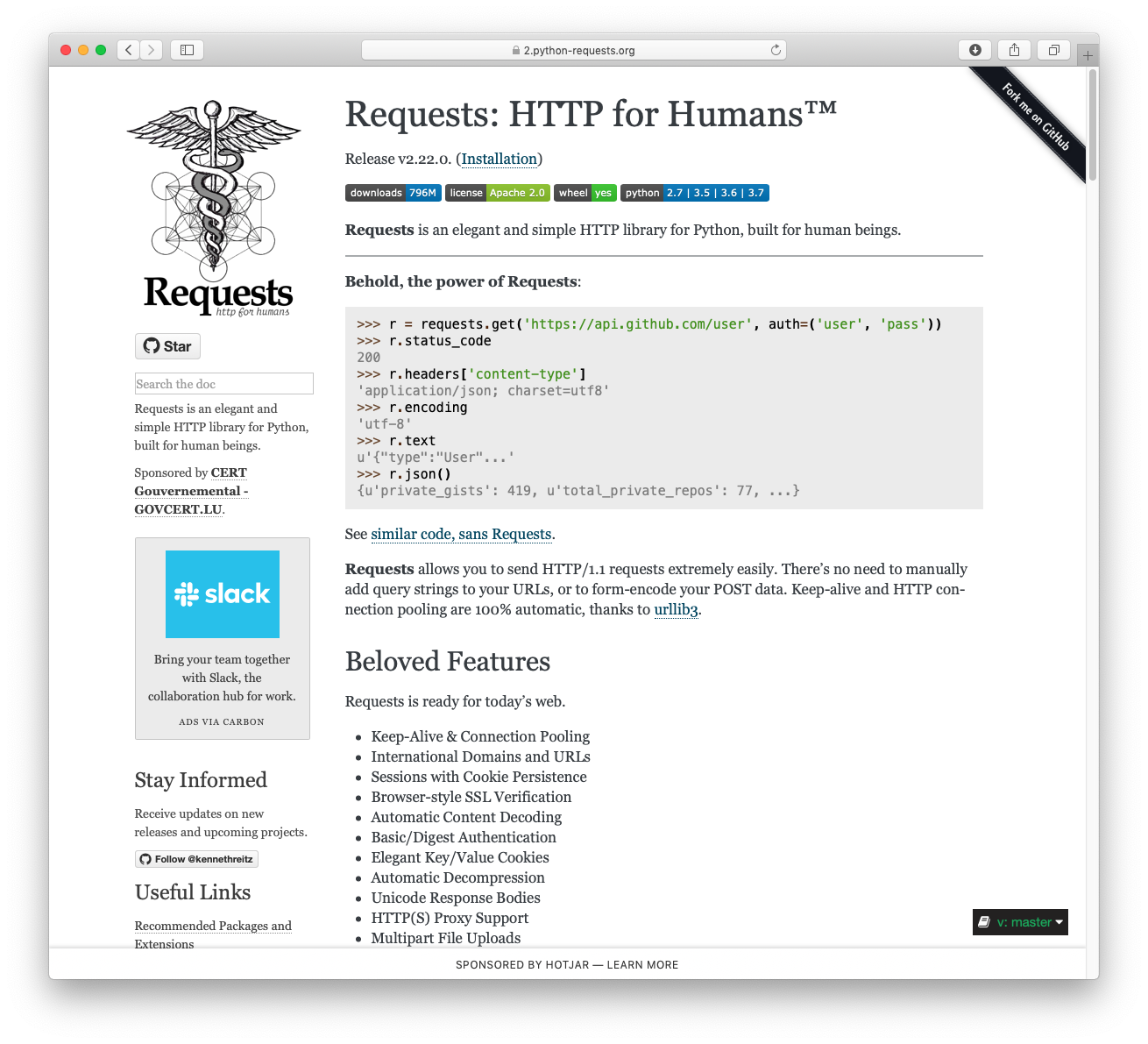](https://requests.readthedocs.io)
## Cloning the repository
When cloning the Requests repository, you may need to add the `-c
fetch.fsck.badTimezone=ignore` flag to avoid an error about a bad commit (see
[this issue](https://github.com/psf/requests/issues/2690) for more background):
```shell
git clone -c fetch.fsck.badTimezone=ignore https://github.com/psf/requests.git
```
You can also apply this setting to your global Git config:
```shell
git config --global fetch.fsck.badTimezone ignore
```
---
[](https://kennethreitz.org) [](https://www.python.org/psf)
PK`ZZZI�!�\\ requests-2.31.0.dist-info/WHEELWheel-Version: 1.0
Generator: bdist_wheel (0.40.0)
Root-Is-Purelib: true
Tag: py3-none-any
PK`ZZZ'��. 'requests-2.31.0.dist-info/top_level.txtrequests
PK`ZZZE����� requests-2.31.0.dist-info/RECORDrequests/__init__.py,sha256=LvmKhjIz8mHaKXthC2Mv5ykZ1d92voyf3oJpd-VuAig,4963
requests/__version__.py,sha256=ssI3Ezt7PaxgkOW45GhtwPUclo_SO_ygtIm4A74IOfw,435
requests/_internal_utils.py,sha256=nMQymr4hs32TqVo5AbCrmcJEhvPUh7xXlluyqwslLiQ,1495
requests/adapters.py,sha256=v_FmjU5KZ76k-YttShZYB5RprIzhhL8Y3zgW9p4eBQ8,19553
requests/api.py,sha256=q61xcXq4tmiImrvcSVLTbFyCiD2F-L_-hWKGbz4y8vg,6449
requests/auth.py,sha256=h-HLlVx9j8rKV5hfSAycP2ApOSglTz77R0tz7qCbbEE,10187
requests/certs.py,sha256=Z9Sb410Anv6jUFTyss0jFFhU6xst8ctELqfy8Ev23gw,429
requests/compat.py,sha256=yxntVOSEHGMrn7FNr_32EEam1ZNAdPRdSE13_yaHzTk,1451
requests/cookies.py,sha256=kD3kNEcCj-mxbtf5fJsSaT86eGoEYpD3X0CSgpzl7BM,18560
requests/exceptions.py,sha256=DhveFBclVjTRxhRduVpO-GbMYMID2gmjdLfNEqNpI_U,3811
requests/help.py,sha256=gPX5d_H7Xd88aDABejhqGgl9B1VFRTt5BmiYvL3PzIQ,3875
requests/hooks.py,sha256=CiuysiHA39V5UfcCBXFIx83IrDpuwfN9RcTUgv28ftQ,733
requests/models.py,sha256=-DlKi0or8gFAM6VzutobXvvBW_2wrJuOF5NfndTIddA,35223
requests/packages.py,sha256=DXgv-FJIczZITmv0vEBAhWj4W-5CGCIN_ksvgR17Dvs,957
requests/sessions.py,sha256=-LvTzrPtetSTrR3buxu4XhdgMrJFLB1q5D7P--L2Xhw,30373
requests/status_codes.py,sha256=FvHmT5uH-_uimtRz5hH9VCbt7VV-Nei2J9upbej6j8g,4235
requests/structures.py,sha256=-IbmhVz06S-5aPSZuUthZ6-6D9XOjRuTXHOabY041XM,2912
requests/utils.py,sha256=6sx2X3cIVA8BgWOg8odxFy-_lbWDFETU8HI4fU4Rmqw,33448
requests-2.31.0.dist-info/LICENSE,sha256=CeipvOyAZxBGUsFoaFqwkx54aPnIKEtm9a5u2uXxEws,10142
requests-2.31.0.dist-info/METADATA,sha256=eCPokOnbb0FROLrfl0R5EpDvdufsb9CaN4noJH__54I,4634
requests-2.31.0.dist-info/WHEEL,sha256=pkctZYzUS4AYVn6dJ-7367OJZivF2e8RA9b_ZBjif18,92
requests-2.31.0.dist-info/top_level.txt,sha256=fMSVmHfb5rbGOo6xv-O_tUX6j-WyixssE-SnwcDRxNQ,9
requests-2.31.0.dist-info/RECORD,,
PK`ZZZJH�vcc�requests/__init__.pyPK`ZZZ�E�����requests/__version__.pyPK`ZZZ�(�����}requests/_internal_utils.pyPK`ZZZT� (aLaL��requests/adapters.pyPK`ZZZ�yCC11� hrequests/api.pyPK`ZZZ8wf��'�'�~�requests/auth.pyPK`ZZZ�z�<���w�requests/certs.pyPK`ZZZ�.`1���S�requests/compat.pyPK`ZZZ/P���H�H�.�requests/cookies.pyPK`ZZZ��ķ�����requests/exceptions.pyPK`ZZZ�U�##��requests/help.pyPK`ZZZ��G���Grequests/hooks.pyPK`ZZZ��������Srequests/models.pyPK`ZZZ�H�����requests/packages.pyPK`ZZZH�Q��v�v� �requests/sessions.pyPK`ZZZ�t�.���� requests/status_codes.pyPK`ZZZQL�`
`
��0requests/structures.pyPK`ZZZ_�j����5<requests/utils.pyPK`ZZZ��˞'�'!�
�requests-2.31.0.dist-info/LICENSEPK`ZZZRм�"���requests-2.31.0.dist-info/METADATAPK`ZZZI�!�\\ �C�requests-2.31.0.dist-info/WHEELPK`ZZZ'��. '���requests-2.31.0.dist-info/top_level.txtPK`ZZZE����� �*�requests-2.31.0.dist-info/RECORDPK*W